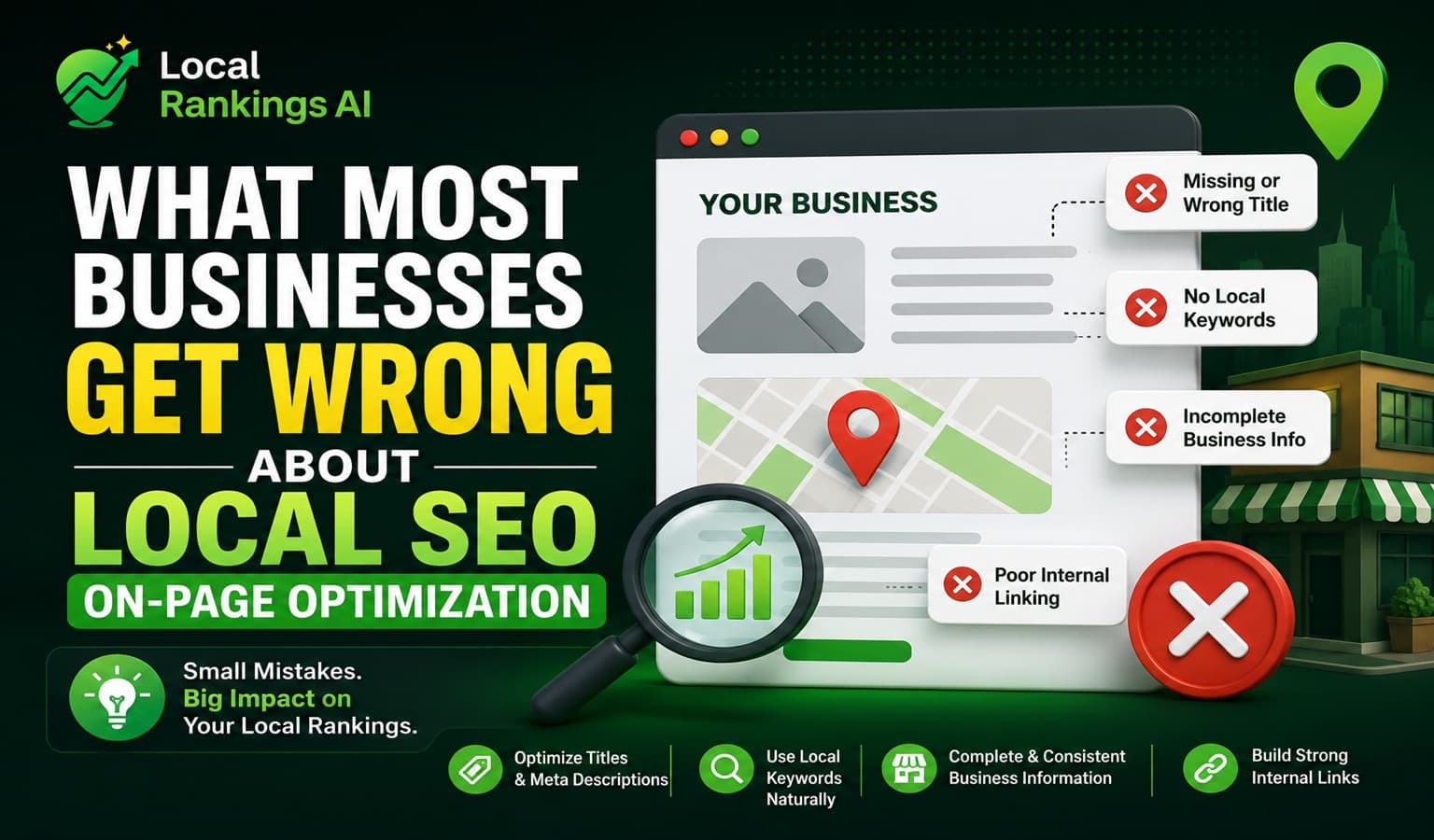
Local SEO mastery requires optimizing title tags, meta descriptions, and header tags with city-specific keywords, embedding Google Maps on contact pages, and maintaining consistent NAP (Name, Address, Phone) citations across 50+ directories. Schema markup for LocalBusiness, geo-tagged images, and location-specific landing pages boost rankings within 3-6 months.
Business name, address, and phone details must match exactly across pages, while location-specific keywords appear naturally in titles and headers. Optimizing for proximity, relevance, and trustworthiness—like the example pizzeria ranking #1 with a 4.7/5 rating from 994 reviews—drives stronger local pack visibility.
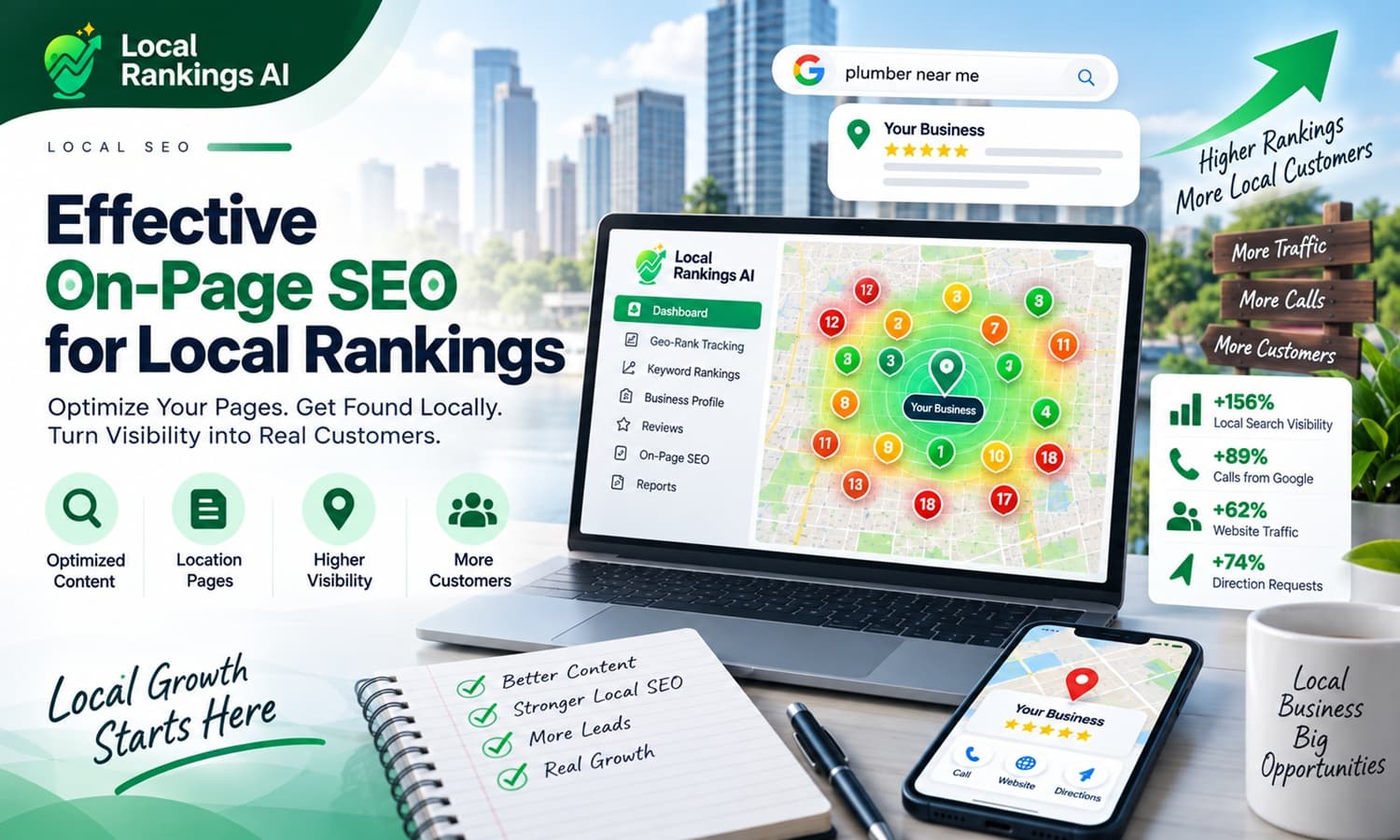
Local SEO on-page mastery requires optimizing Google Business Profiles, embedding location-specific keywords in titles and headers, and maintaining consistent name-address-phone details across pages. Local Rankings AI's geo-rank grid tracks street-level ranking changes across service areas, exposing exactly where a business underperforms so owners can prioritize fixes that measurably elevator local search visibility.
Key Takeaways
Local SEO helps Google understand your business location, offerings, and trustworthiness for improved rankings.
Optimize for location-based search queries like "Indian takeout downtown Montreal" to capture local intent.
Top-ranking local businesses appear in the local pack and organic blue link results simultaneously.
Search engines treat "mechanic" and "near me" searches as local queries requiring location optimization.
What Do You Need Before You Start?
Two things come before any keyword edit or citation cleanup: a location signal Google can trust and a clear picture of current standing. Local SEO on-page optimization techniques only work when Google already understands where a business sits, what it sells, and how trustworthy it looks to searchers. Skip that groundwork and even well-written pages struggle to rank.
Why does a rankings map matter before making changes?
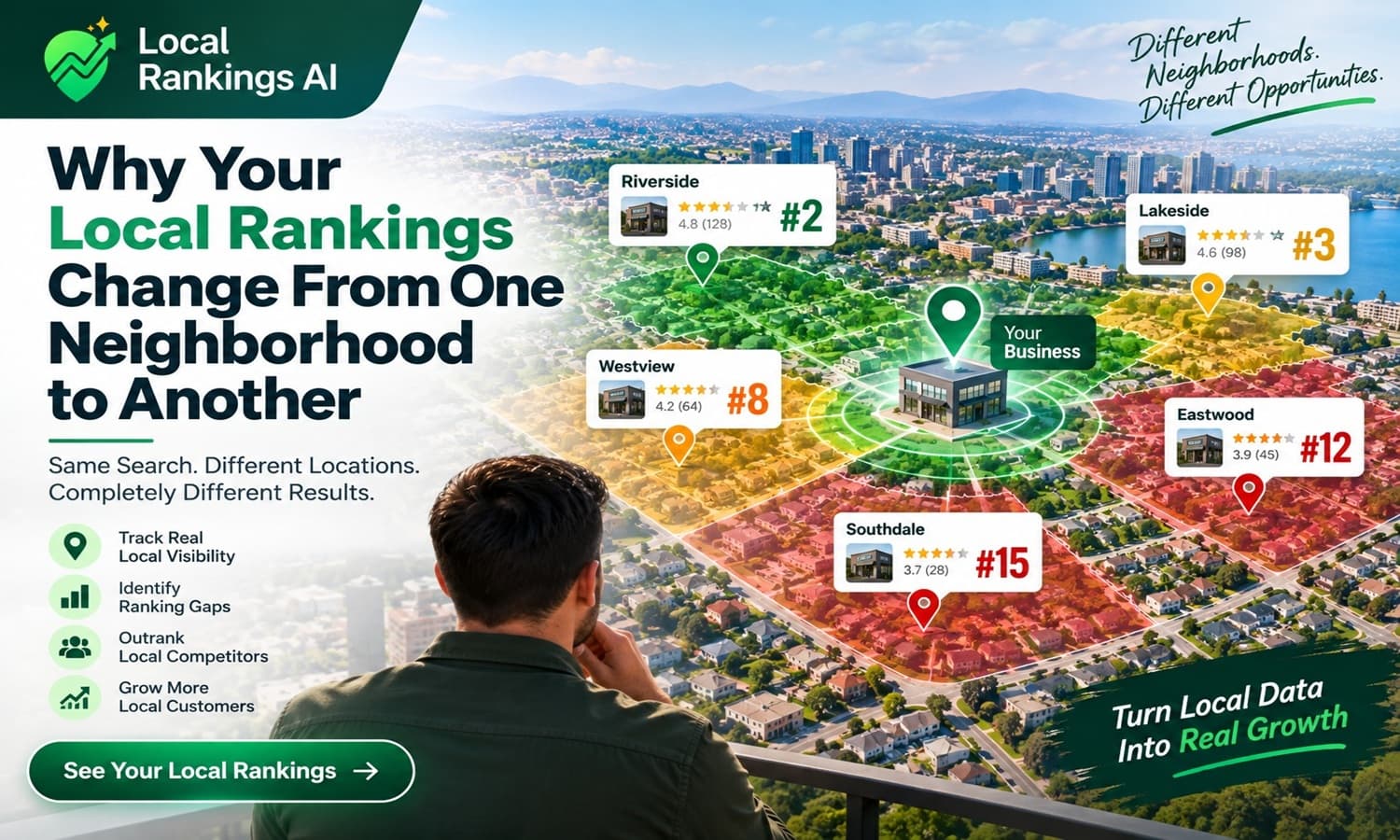
A single search from an owner's desk does not tell the whole story. Rankings shift street by street, so a business might sit at the top of results downtown and fall out of view three miles away. A free rankings map solves this by showing exactly where a business ranks across its full service area. Where competitors have moved in.
What technical basics need to be in place first?
Search engines need to crawl, index, and understand a site before any on-page work pays off. Confirm the basics using this checklist:
Pages load without errors and get indexed by Google
Site structure lets search engines follow internal links easily
Location, services, and contact details appear in clear, readable text
Business information matches across the website and the Google Business Profile
With crawlability confirmed and a baseline map in hand, on-page changes have something solid to build on.
How Do You Optimize Each Page, Step By Step?
Optimizing a business page requires a defined sequence, not scattered edits. Local SEO on-page optimization techniques work best when audits come first, structural fixes come second, and ranking checks come last. Skipping the audit step means guessing at problems instead of fixing confirmed ones. Guesswork wastes marketing hours that competitors spend climbing past a business in local map results.
Follow this sequence for each page on a business website:
Run a business profile audit across Google, Bing, Apple, and Yelp before touching any page. This step reveals inconsistent names, addresses, and phone numbers that quietly undercut rankings.
Check current geo-rank position using a precision geo-rank grid that tracks visibility across the entire service area, not just one central location. This surfaces underperforming neighborhoods hidden inside a single average ranking number.
Rewrite page content to match what local searchers actually type, including neighborhood names and service specifics.
Rebuild location and service pages so each one targets a distinct area instead of duplicating the same copy sitewide.
Re-scan the geo-rank grid weekly to confirm street-level movement after each change.
Why does step order matter for ranking results?
Order matters because unranked issues compound. A business that skips the audit often optimizes content on a page while a mismatched address elsewhere blocks trust signals entirely.
Which page elements should get fixed first?
Business profile accuracy comes first, since 60% of smartphone users contact a business directly through local search results. Location-specific content comes next; 78% of people searching nearby on a phone visit within a day. 28% of those searches end in a purchase.
What Should You Check When Rankings Don't Improve?
Stalled rankings usually trace back to a single flawed assumption: one search from a business's own address proves nothing. Rankings shift block by block, so a business owner checking from behind the counter sees a distorted picture. Diagnosing the real problem requires a structured review, not another guess about local SEO on-page optimization techniques.
Why does a business rank well nearby but disappear a few miles away?
Local search results change street by street, not city by city. A business owner testing only from headquarters misses every underperforming zone across the actual service area.
What's the fastest way to confirm optimization work is paying off?
Track results with client-ready documentation instead of instinct. Clean proof shows whether changes are moving rankings or wasting effort.
Map rankings across the full service area, not one location.
Compare Google Business Profile visibility against nearby competitors.
Confirm the business appears on the map for high-intent searches, since unestablished brands rarely rank without it.
Mastering on-page local SEO optimization requires a strategic, data-driven approach that aligns your website content, technical foundation, and business profile with local search intent. By implementing these techniques consistently—from keyword optimization to schema markup to profile management—you establish the visibility foundation necessary to attract qualified local customers. The businesses that succeed treat local SEO as an ongoing commitment, not a one-time project, continuously refining their approach based on performance metrics and ranking changes across their service areas.