How to Read a Local Rank Tracking Report: Metrics That Actually Matter
Learn how to read a local rank tracking report by focusing on the SEO metrics that matter most. Turn rankings into actionable insights to improve local search visibility.

Most business owners open a rank tracking report, glance at one number, and close the tab. That number usually feels good or bad for about thirty seconds, and then nothing changes because nobody actually understood what the rest of the report was saying.
The truth is, a good local rank tracking report has far more useful information in it than a single position number. Once you know what to actually look at, the report stops being a confusing wall of charts and starts being a tool you can use to make real decisions about where to focus next.
Reading Your Rank Tracking Report: The Metrics That Actually Tell You Something
Why a Single Ranking Number Isn't Enough
If you've only ever checked your ranking from one search, you've probably seen a number like "#3 for a plumber near me" and assume that's how your customers see you. In reality, that number only reflects one search, from one location, at one moment in time.
Local rankings shift depending on where the search happens. Someone searching from one side of your service area might see you at the top, while someone a few streets away might not see you at all. A report built around a single average position hides this completely, which is exactly why grid-based rank tracking exists - it shows your visibility across your whole service area instead of pretending one number tells the whole story.
Schedule Demo
The Core Metrics Worth Paying Attention To
1. Grid Coverage and Rank Points
A geo-rank report typically scans your visibility across a grid of points spread over your service area - for example, a 7×7 grid covers 49 separate locations. Each point shows where you rank for a given search at that exact spot. Instead of one number, you get a full map of your visibility.
What to look for: How many of those points show you in the top positions versus how many show you buried or missing entirely. A business that's strong in the center but disappears at the edges has a coverage problem, not just a ranking problem.
2. Visibility by Platform
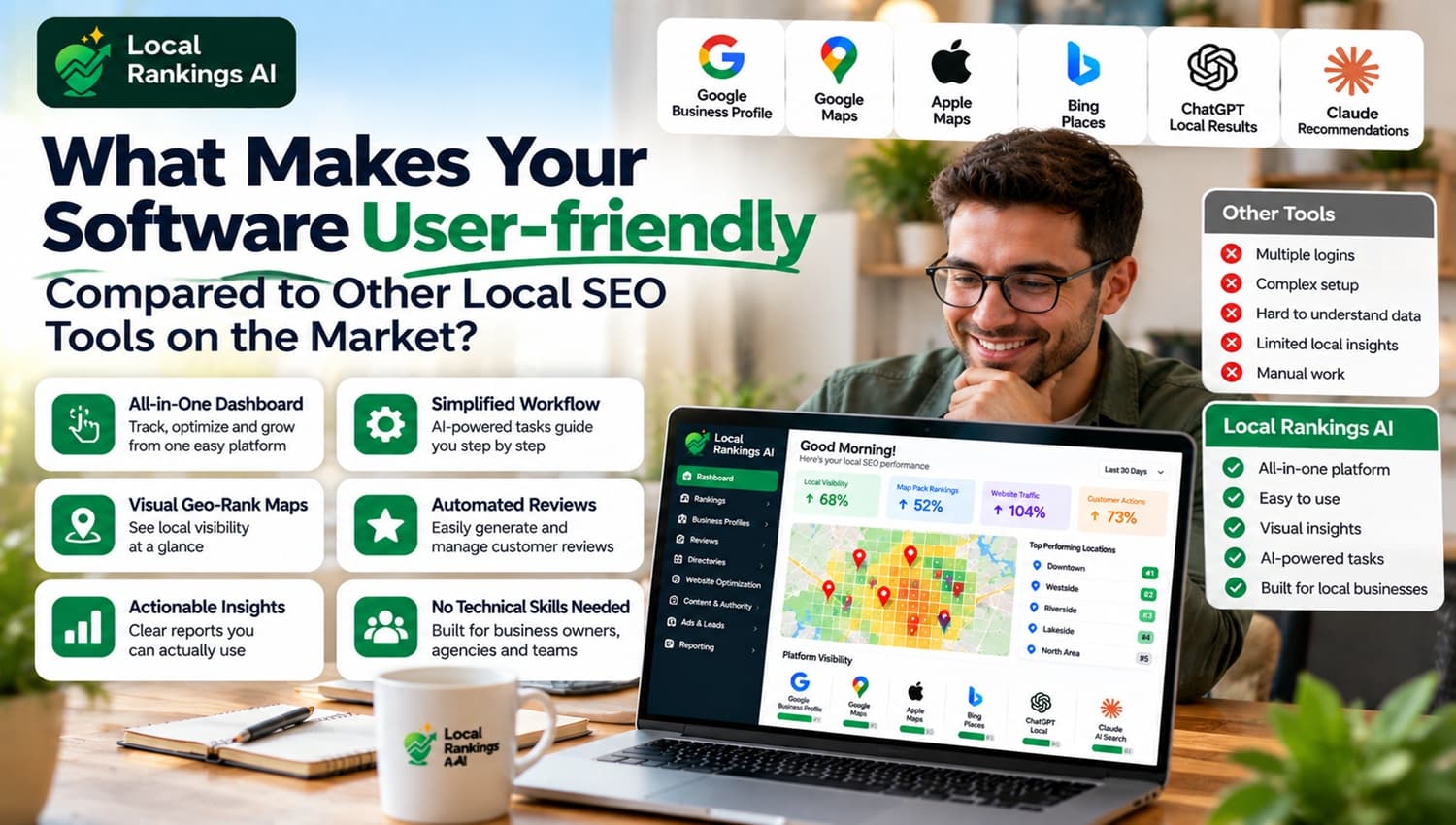
Customers don't only search on Google. They search Bing, Apple Maps, and increasingly, AI assistants like ChatGPT. A report that only tracks Google rankings is only showing part of the picture.
What to look for: Whether your visibility is consistent across platforms, or whether you're strong on Google Maps but invisible everywhere else. If one platform is sending you customers and another isn't, that's a clear signal of where to put your attention next.

.png&w=3840&q=75)
