On Page SEO for Local Rankings: Fix Visibility Gaps & Get More Leads | Local Rankings AI
Effective On-Page SEO for Local Rankings: What Actually Improves Local Visibility
Local rankings don’t stop at your homepage. Discover how strategic on-page SEO, location-specific content, internal linking, and geo-rank tracking can expose local visibility gaps, strengthen relevance, and turn underperforming service areas into measurable traffic, leads, calls, and customers.
Ranking locally is not simply about adding a city name to a page.
For a local business, effective on-page SEO means making it unmistakably clear what you offer, where you offer it, and why your business is relevant to the searcher. That information then needs to align with your Google Business Profile, website, and broader local signals.
Google states that local results are primarily influenced by relevance, distance, and prominence. Relevance determines how closely a business matches the search, distance considers the searcher's location, and prominence reflects how well known the business is, including signals such as links and reviews.
That is why local on-page SEO should be treated as part of a larger visibility system, not as keyword placement alone.
Key Takeaways
Build each important page around a clear search intent, service, and geographic relevance.
Write useful local content for customers rather than inserting city names simply to influence rankings.
Optimize titles, headings, URLs, body content, images, and internal links around the actual topic of the page.
Create location pages only when they provide genuinely useful, unique information.
Keep your website and Google Business Profile information accurate and consistent.
Use structured data where it accurately represents the page and business.
Connect service pages, location pages, and supporting content through logical internal links.
Measure rankings across multiple locations rather than assuming one ranking represents your entire market.
Connect SEO visibility with meaningful outcomes such as organic traffic, calls, inquiries, and conversions.
What Makes On-Page SEO Important for Local Search?
A well-optimized local page helps search engines understand three fundamental things:
What service does the business provide?
Which location or service area does it serve?
What information makes the page useful to potential customers?
Your source material correctly identifies local keyword research, optimized title tags, geo-specific landing pages, and location-focused content as important components of an effective local SEO strategy.
But there is an important distinction:
On-page SEO can strengthen relevance. It cannot eliminate the impact of distance.
A plumber may have an excellent page targeting "emergency plumber," but a competitor located much closer to the searcher may still have an advantage in local results because distance is one of Google's stated local ranking factors.
This is why measuring rankings across the entire service area is more informative than checking one Google Maps result.
1. Build Pages Around Real Local Search Intent
Start with the service customers actually search for rather than creating pages simply to target geographic keywords.
For example:
Weak: Plumbing Services in Dallas
Stronger: Emergency Plumber in Dallas | 24/7 Emergency Plumbing
The second example communicates the service, location, and customer intent more clearly.
Your keyword research should identify:
Core services
High-intent service keywords
City and neighborhood modifiers
Problem-based searches
"Near me" variations
Commercial versus informational intent
The objective is not to insert more keywords. It is to build a page that provides the information a local searcher actually needs.
2. Optimize Title Tags and Headings
Your title tag and primary heading should establish the page's topic immediately.
A useful structure is:
Primary Service + Location + Differentiator
For example:
Kitchen Remodeling in San Jose | Custom Design & Renovation
Your H1 should reinforce the primary topic, while H2s can address questions such as:
What kitchen remodeling services do you provide?
How much does kitchen remodeling cost?
Which San Jose neighborhoods do you serve?
What makes your remodeling process different?
This creates a logical relationship between search intent, service relevance, and location relevance.
3. Create Useful Location Pages
Location pages can be valuable when a business genuinely serves multiple areas.
However, creating dozens of near-identical pages with only the city name changed is not a strong local SEO strategy.
A useful location page should contain genuinely relevant information such as:
Services available in that area
Neighborhoods or communities served
Local customer considerations
Project examples
Service-specific FAQs
Relevant business information
Clear conversion opportunities
Google also explains that it gathers local business information from multiple sources, including publicly available web content such as a business's official website.
That makes consistency between your website and business information particularly important.
4. Connect Your Website With Your Local Business Profile
Google specifically states that complete and accurate Business Profile information can help a business appear for relevant local searches.
You can also strengthen Google's understanding of the business using appropriate Local Business structured data. Google recommends using the most specific applicable Local Business type and validating structured data before deployment.
Structured data is not a shortcut to higher rankings. Its primary purpose is to help search engines understand the information presented on your pages.
5. Measure Rankings Beyond One Location
This is where many local SEO strategies break down.
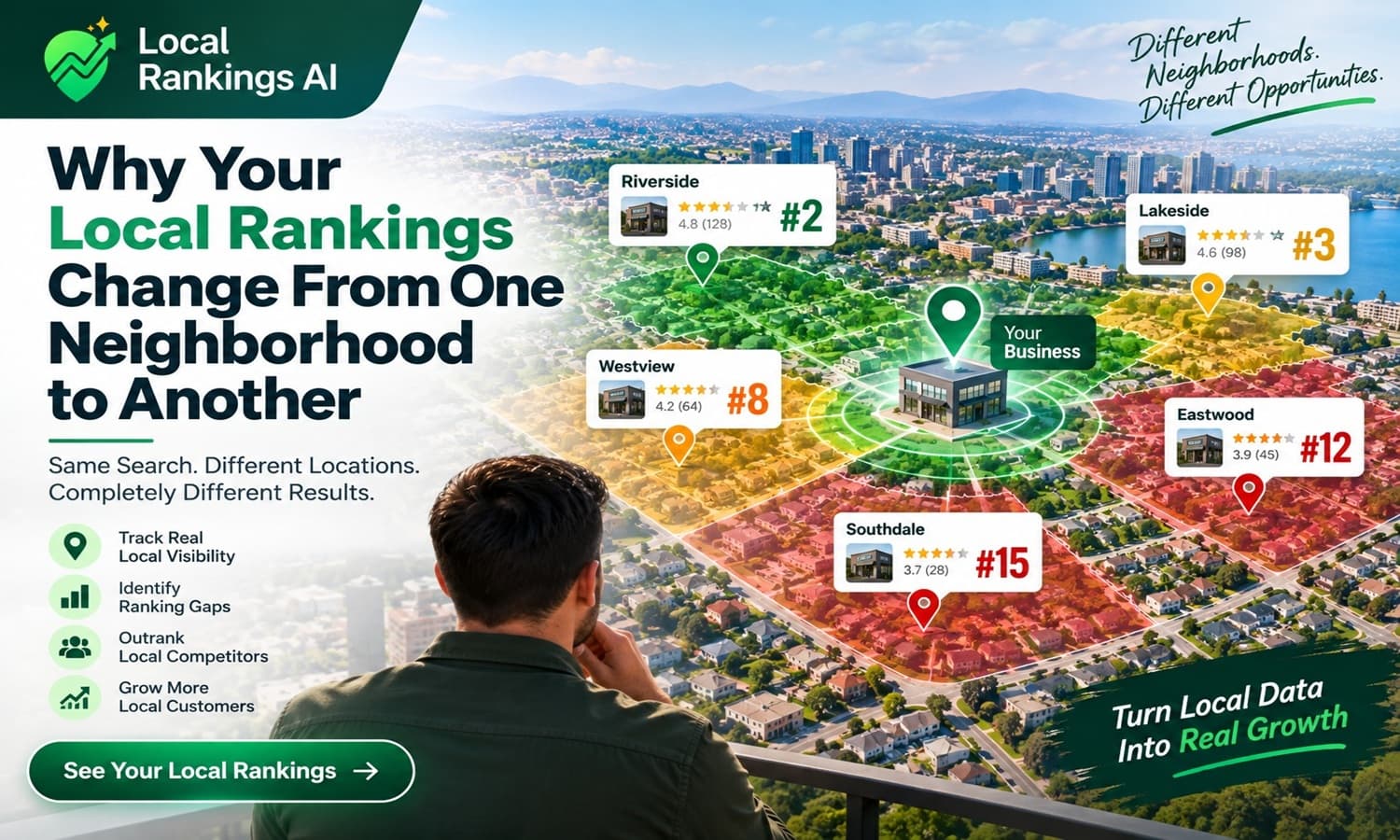
A business might rank #2 when the owner searches from the office and #15 several miles away.
Both results can be accurate.
Local Rankings AI's geo-rank tracking approach uses a grid of search locations to show how visibility changes throughout a service area. A common configuration is a 7 × 7 grid containing 49 geographic points, producing a visual ranking heatmap.
Instead of asking:
"What is my Google ranking?"
a better question is:
"Where am I visible, and where am I losing visibility?"
That difference matters.
A citywide ranking average can hide neighborhoods where competitors consistently outperform your business.
How to Turn Ranking Data Into On-Page Improvements
Suppose your geo-rank data shows:
Strong rankings around your business
Moderate rankings several miles away
Weak rankings in a specific part of your service area
Don't immediately rewrite the entire website.
Investigate the weak area first.
Ask:
Do we have a relevant location or service page?
Does that page clearly explain the service?
Is the location genuinely covered?
Does the page answer local customer questions?
Are internal links pointing to the page?
Is the Google Business Profile information accurate?
Are competitors stronger in that geographic area?
This turns ranking data into an actionable SEO workflow, rather than simply another reporting metric.
The Metrics That Actually Matter
Rankings are useful, but rankings alone do not demonstrate business growth.
A stronger local SEO measurement framework connects:
HubSpot's 2025 marketing data reported that website, blog, and SEO efforts were among the leading ROI channels for B2B brands in 2024. That broader marketing evidence reinforces the importance of connecting SEO activity to measurable business outcomes rather than reporting rankings alone.
For local businesses, the same principle applies: visibility is valuable when it contributes to customer acquisition.
A Practical Local On-Page SEO Workflow
A focused workflow looks like this:
1. Identify high-intent services Find the services that generate revenue, not simply traffic.
2. Map services to locations Determine where the business genuinely operates.
4. Create useful location pages where necessary Only when the location has real business relevance.
5. Align website and Business Profile information Keep critical business information accurate and consistent.
6. Measure geographic visibility Use geo-rank tracking instead of relying on a single manual search.
7. Fix the weakest areas first Use ranking data to identify where optimization can have the greatest practical value.
8. Measure business outcomes Connect SEO visibility to leads, calls, appointments, and revenue.
Common Local On-Page SEO Mistakes
Avoid these common problems:
Repeating city names unnaturally
Creating duplicate location pages
Optimizing every page for the same keyword
Writing content primarily for search engines
Ignoring internal linking
Publishing location pages without unique local value
Treating one ranking position as the complete picture
Ignoring Google Business Profile accuracy
Measuring rankings without tracking leads
The biggest mistake is often optimizing what is easy to measure instead of what affects the business.
The Bottom Line
Effective local on-page SEO is not about putting a city name into every heading.
It is about building a clear relationship between service, location, search intent, website content, business information, and measurable local visibility.
Google's own guidance makes clear that local rankings depend primarily on relevance, distance, and prominence. On-page SEO has its greatest role in strengthening the relevance and clarity of your website and supporting the broader local search ecosystem.
And because local rankings can vary substantially by search location, businesses should measure visibility across their actual service area rather than relying on a single Google search. Local Rankings AI's geo-rank approach is designed around precisely this problem: identifying where visibility is strong, where it is weak, and where optimization should be focused next.
The goal of local SEO isn't simply to rank higher. It's to become visible in the places where your customers are actually searching—and turn that visibility into measurable business results.


.png&w=3840&q=75)