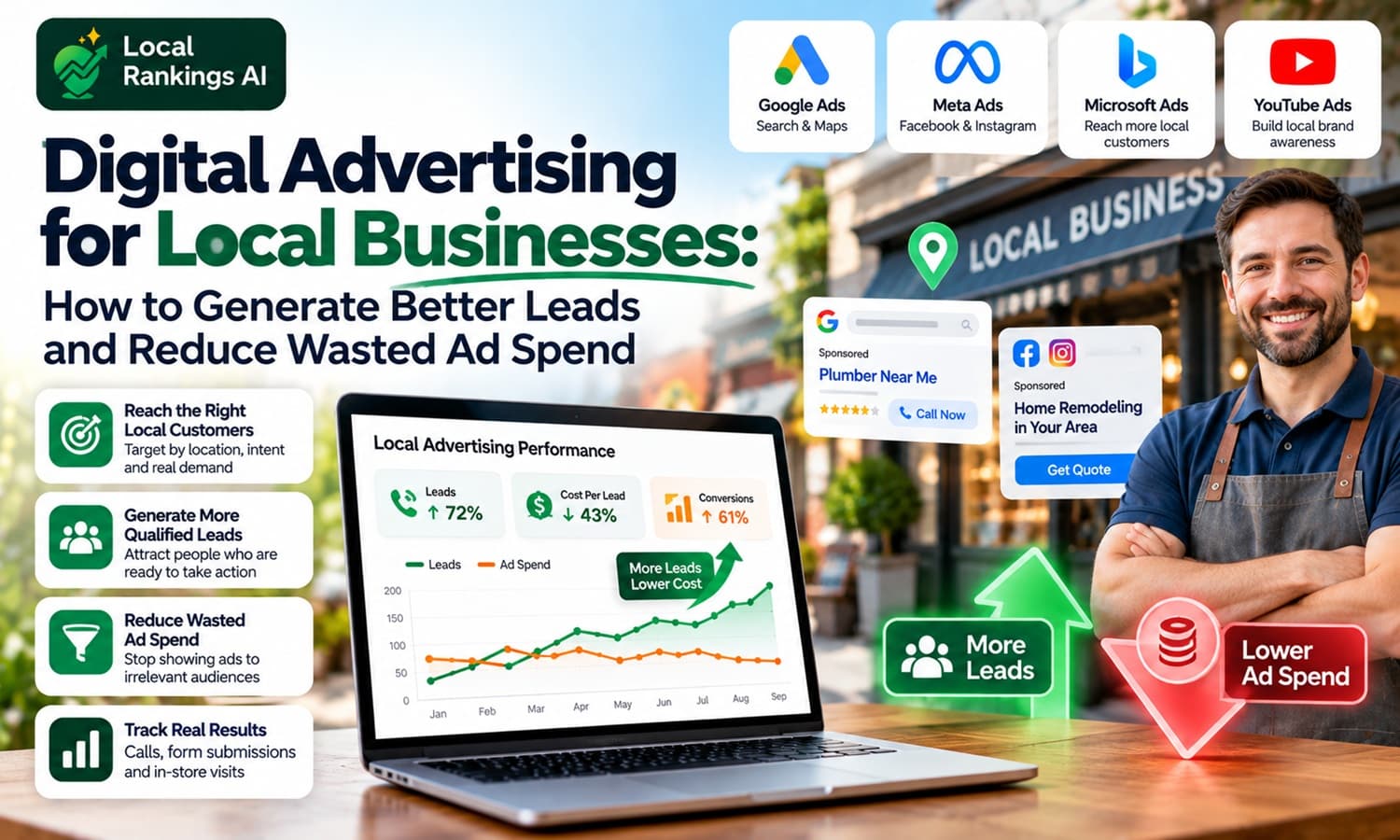
More Ad Clicks Do Not Necessarily Mean More Customers
For a local business, digital advertising should do more than generate impressions, website visits, or phone calls. It should help bring in customers who need the services you provide, live within your service area, and are likely to become paying clients.
Consider a home remodeling company advertising its services across a metropolitan area. Its campaigns might generate hundreds of clicks, but some visitors may be outside its service radius, looking for services the company does not offer, or simply researching prices without any immediate intention to hire.
The advertising budget is being spent, but the business may not be getting enough qualified enquiries to justify that investment.
This is why effective digital advertising for local businesses requires more than launching a Google Ads campaign. It requires understanding local demand, selecting appropriate targeting settings, matching ads to customer intent, measuring meaningful conversions, and improving campaigns using actual performance data.
According to Google's guidance on optimizing Search campaigns, conversion tracking helps advertisers evaluate which actions matter to their business and assess campaign performance beyond basic traffic metrics.
Local Rankings AI addresses this challenge by combining professionally managed digital advertising with a broader local growth strategy, helping businesses capture paid search demand while continuing to develop their organic visibility.
1. Why Local Businesses Need a Different Digital Advertising Strategy
A national e-commerce brand and a local service business may both use Google Ads, but their advertising priorities are often very different.
A local plumber, painting contractor, dentist, or remodeling company usually needs customers in specific cities, neighborhoods, or service areas. Reaching someone hundreds of miles away may create traffic without creating a realistic sales opportunity.
An effective local advertising strategy starts with three questions:
Who is the ideal customer? Identify the services, needs, and buying signals that indicate a genuine prospect.
Where can the business serve customers profitably? Define the relevant cities, neighborhoods, and geographic areas.
What action represents a valuable lead? Determine whether success means a qualified phone call, estimate request, appointment, or completed sale.
Google Ads supports geographic targeting by location, including cities and other eligible geographic areas. Google also recommends reviewing location-level performance to identify where advertising performs best and where budgets may need adjustment.
For example, a kitchen remodeling contractor serving Austin and nearby communities could separate campaigns by service area or service type when sufficient demand and budget justify doing so. This makes it easier to assess whether advertising is reaching the intended market and producing relevant enquiries.
How Local Rankings AI helps
Local Rankings AI offers managed digital advertising designed around a business's goals, target markets, and local customer demand. Its service includes campaign strategy, geographic targeting, ongoing optimization, conversion tracking, and reporting.
Rather than leaving business owners to manage campaign settings and interpret advertising data themselves, the service provides professional campaign management alongside the platform's wider local SEO capabilities.
“Get an interior painting estimate near me” suggests a more immediate service need.
These queries represent different stages of the customer journey. A business that allocates its entire budget to broad, loosely related keywords may attract visitors who are unlikely to become customers.
A stronger strategy involves matching keywords, ad messaging, and landing pages to the services being promoted.
Four ways to improve search intent targeting
Prioritize commercial and transactional queries. Identify searches that suggest a person is comparing providers, requesting a quote, or looking to hire.
Review actual search terms. Look for irrelevant queries consuming budget and add negative keywords where appropriate.
Match ads to the service. A kitchen remodeling ad should lead to a relevant remodeling page, not a generic homepage.
Evaluate lead quality. A keyword that generates fewer enquiries may still be more valuable if those enquiries turn into profitable jobs.
How Local Rankings AI helps
Local Rankings AI's managed advertising service focuses on reaching high-intent local customers and continually refining campaigns using performance data. Its wider platform also supports local SEO and website optimization, which can help businesses address the organic visibility and landing-page experience surrounding their advertising campaigns.
The objective is not simply to generate more traffic. It is to build a more deliberate path from a relevant search to a qualified enquiry.
3. Reduce Wasted Ad Spend With Geographic Targeting
For businesses that serve a defined area, geographic targeting is a major part of campaign efficiency.
A contractor may serve five nearby cities but receive most of its profitable enquiries from just two. A dental practice may need to concentrate on a smaller catchment area, while a commercial service provider may operate across several counties.
Using one broad geographic target without reviewing performance can make it harder to understand where advertising is producing value.
Google recommends examining geographic performance, adjusting investment in stronger-performing areas, and excluding regions that do not perform well when appropriate.
Example: Local advertising budget review
Illustrative scenario only, not actual Local Rankings AI client results.
Service area
Ad spend
Qualified leads
Cost per qualified lead
Austin North
$600
12
$50
Austin South
$600
6
$100
Outer service area
$600
3
$200
In this hypothetical example, the outer service area has the highest cost per qualified lead. Before cutting its budget, the advertiser should check lead quality, job values, travel costs, conversion delays, and whether the sample is large enough to support a decision.
This type of analysis is more useful than comparing areas by clicks alone.
How Local Rankings AI helps
Local Rankings AI's Digital Ads service includes local market targeting, ongoing campaign optimization, and reporting. This creates a framework for reviewing campaign performance against the markets the business actually wants to serve.
For a business operating in multiple cities, this approach can help inform where to investigate opportunities, which campaigns need refinement, and where advertising investment may be better aligned with demand.
4. Measure Qualified Leads, Not Just Clicks and Calls
A campaign can report a strong click-through rate and still deliver poor business results.
The reason is straightforward: a click is an interaction, not a sale. Even a phone call or form submission may not be a qualified opportunity.
For example, a painting company might receive 40 enquiries in a month, but some could involve locations it does not serve, jobs below its minimum project size, or people seeking services outside its expertise.
To understand advertising performance, businesses need to measure what happens after the initial enquiry.
The metrics that matter
Metric
What it tells you
Cost per lead
How much advertising spend produces an enquiry
Cost per qualified lead
How much spend produces a relevant sales opportunity
Lead-to-customer rate
How effectively enquiries turn into customers
Customer acquisition cost
How much it costs to acquire a paying customer
Return on ad spend (ROAS)
Advertising-attributed revenue relative to ad spend, where revenue tracking is available
Profitability
Whether the resulting jobs generate enough margin to justify the investment
Google Ads supports conversion tracking for actions such as calls, purchases, and sign-ups. Its qualified-lead and converted-lead functionality can also help eligible advertisers connect advertising interactions with subsequent sales outcomes.
For service businesses, a practical measurement setup should distinguish between a new enquiry, a qualified lead, an estimate or consultation, and a completed sale whenever the available systems and data support it.
How Local Rankings AI helps
The Digital Ads service explicitly includes conversion tracking, ongoing optimization, and clear monthly reporting.
These elements help businesses move beyond surface-level metrics and evaluate how their campaigns are performing against lead generation goals.
For the strongest analysis, businesses should also maintain reliable records of qualified enquiries and closed jobs so campaign decisions can account for sales outcomes, not just the initial response.
5. Improve the Landing Page Before Increasing the Budget
More advertising traffic will not fix a landing page that fails to convert.
Imagine a homeowner clicking an ad for cabinet painting. If the landing page primarily discusses unrelated exterior painting services, provides little information about the process, or makes it difficult to request an estimate, the visitor may leave without contacting the company.
A landing page should make the next step obvious and reassure visitors that they have found the right provider.
A conversion-focused landing page should include
A clear headline matching the advertised service and location.
Specific information about the service, scope, and benefits.
Relevant project photos, testimonials, or other verifiable trust signals.
A prominent call, booking, or estimate-request option.
Mobile-friendly navigation and a simple enquiry form.
Consistent information about service areas and contact details.
For example, an ad promoting “Cabinet Painting in Waukesha, WI” should ideally direct visitors to a relevant cabinet painting page rather than forcing them to search through a general list of services.
This creates continuity between the customer's original search, the advertisement, and the page where they are expected to take action.
How Local Rankings AI helps
Local Rankings AI combines digital advertising with broader local growth services, including website optimization and local SEO. The platform's wider offering is designed to help businesses identify visibility and website opportunities alongside paid acquisition.
This broader perspective matters because campaign performance depends not only on the ad itself, but also on the experience customers encounter after clicking.
6. Combine Paid Advertising With Organic Local SEO
Paid advertising and organic local SEO solve related but different problems.
Paid campaigns can help a business appear for relevant searches while the campaign is active and eligible to serve. Organic SEO builds longer-term visibility through website relevance, useful content, technical quality, and local authority.
Depending on the market, business objectives, competition, and budget, combining the two can provide a more balanced acquisition strategy.
Paid digital advertising
Capture relevant search demand through managed campaigns, targeted messaging, and conversion-focused optimization.
Organic local SEO
Build visibility through local rankings, Google Business Profile improvements, website optimization, reviews, and relevant content.
A coordinated growth strategy
Use campaign data and organic visibility insights to identify opportunities and prioritize marketing activity.
A business should not assume that running ads automatically improves organic rankings. Paid search and organic search have different ranking systems. Their value comes from supporting different parts of the customer acquisition process.
How Local Rankings AI brings the two together
Local Rankings AI positions its Digital Ads & Lead Generation service as an extension of its broader local growth strategy: paid advertising helps capture demand now, while organic SEO supports longer-term visibility.
This is particularly relevant for service businesses that need enquiries in the near term but also want to develop a stronger local search presence over time.
7. What Should a Local Business Look for in a Digital Advertising Agency?
Choosing an advertising partner should involve more than comparing management fees or promises about lead volume.
A useful evaluation focuses on the process, the measurement framework, and the relevance of the proposed strategy to the business.
Before hiring an agency, ask these questions:
1. How will the campaigns target my service area?
The agency should explain how it will structure geographic targeting, assess performance by location, and reduce irrelevant traffic.
2. How will you measure lead quality?
Ask whether reporting distinguishes between clicks, enquiries, qualified leads, and paying customers where the required data is available.
3. How frequently will campaigns be optimized?
Campaigns should be reviewed against actual results, including search terms, geographic performance, conversion rates, and budget allocation.
4. What happens if my landing page is underperforming?
An effective partner should be able to identify potential issues with the page, offer recommendations, and explain how those issues will be evaluated.
5. How will I understand where my money is going?
Reporting should clearly identify advertising expenditure, relevant performance metrics, and the actions being taken to improve results.
How Local Rankings AI fits these requirements
The published Digital Ads page describes a done-for-you service covering campaign strategy, targeting, campaign management, conversion tracking, ongoing optimization, and monthly reporting.
This service is intended for business owners who want professional advertising management without having to handle every campaign decision themselves.
8. How Much Does Managed Digital Advertising Cost?
Advertising costs vary by industry, location, competition, customer value, and campaign objectives. There is no single budget that guarantees profitable results for every local business.
When evaluating a managed advertising service, distinguish between the management service and the media budget used to run ads.
The published plan includes managed advertising and $250 in monthly advertising spend. Additional advertising budget is available based on business goals and market opportunity.
Explore Digital Ads
Before deciding whether the plan is suitable, businesses should estimate their expected customer value, gross margin, acceptable acquisition cost, and likely lead volume. The listed price alone cannot establish whether a campaign will be profitable.
For example, a business selling high-value remodeling projects will have different acquisition economics from a business providing lower-priced recurring services.
The appropriate budget should be based on realistic market conditions and verified performance, not an assumed number of leads or guaranteed return.
9. A Practical 30-Day Framework for Improving Local Advertising
A structured review helps a business identify weaknesses before making larger budget commitments.
Week 1: Audit the current campaign Review the services advertised, search terms, locations targeted, conversion actions, landing pages, and existing performance data.
Week 2: Refine targeting and messaging Improve keyword relevance, address irrelevant search terms, review geographic settings, and align ad copy with the intended customer.
Week 3: Check conversion quality Test forms and call tracking, review lead records, and identify whether enquiries are relevant and progressing toward sales.
Week 4: Evaluate and prioritize Compare performance against the initial baseline, identify the strongest opportunities, and develop a prioritized list of changes for the next cycle.
This is a review framework, not a promise of results within 30 days. The appropriate evaluation period depends on traffic volume, conversion delays, seasonality, and the amount of reliable data available.
How Local Rankings AI helps
Local Rankings AI's managed advertising service brings campaign execution, conversion tracking, optimization, and reporting together. Its wider platform also supports local SEO and website improvements, allowing businesses to consider paid acquisition alongside their broader local visibility strategy.
For owners who do not have the time or expertise to manage these activities themselves, a done-for-you service can provide a more structured way to execute and evaluate the strategy.
Conclusion: Make Your Advertising Accountable to Business Growth
Successful digital advertising is not simply about appearing in search results. It is about reaching the right customers, in the right locations, with a relevant offer, and measuring what happens after they click.
Local businesses can improve campaign efficiency by refining search intent, reviewing geographic performance, measuring qualified leads, strengthening landing pages, and evaluating advertising alongside organic search visibility.
Local Rankings AI brings these priorities together through professionally managed digital advertising and a broader local growth strategy. Instead of treating paid campaigns as an isolated activity, businesses can use the service to pursue local demand while continuing to develop their organic visibility.