Best Local SEO Marketing Software: How to Choose Right | Local Rankings AI
How to Choose the Best Local SEO Marketing Software for Your Business
Learn how to choose the best local SEO marketing software for your business. Compare features, pricing, and tools to improve local search visibility and growth.
A practical guide for local business owners and agencies who want to rank where their customers actually search - not just where they happen to be standing.
Here's a scenario that plays out more often than most business owners realize: you search for your own business on Google, see yourself at position one or two, and assume your local SEO is working. Then a potential customer a few blocks away searches the same thing - and you don't appear until page two.
That gap is not a coincidence. It's how local search actually works. Google factors in the searcher's exact location when deciding what to show, which means your ranking isn't a single number - it's a moving target that shifts street by street across your entire service area.
Choosing the right local SEO marketing software comes down to whether it helps you understand that reality - and do something about it. This guide walks you through exactly what to look for, what to avoid, and how to evaluate a platform before you commit.
What to Look for in Local SEO Marketing Software Before You Commit
What Local SEO Marketing Software Actually Does
The term gets stretched to cover a lot of tools that don't quite qualify. In practice, local SEO marketing software should do three things well: show you where you're visible across your service area, identify what's limiting your rankings, and give you a clear path to improving them.
This is meaningfully different from general SEO platforms, which focus on broad keyword rankings across the web. Local SEO operates at a completely different scale - the difference between ranking in your city versus ranking in the neighborhood where your next customer is searching right now.
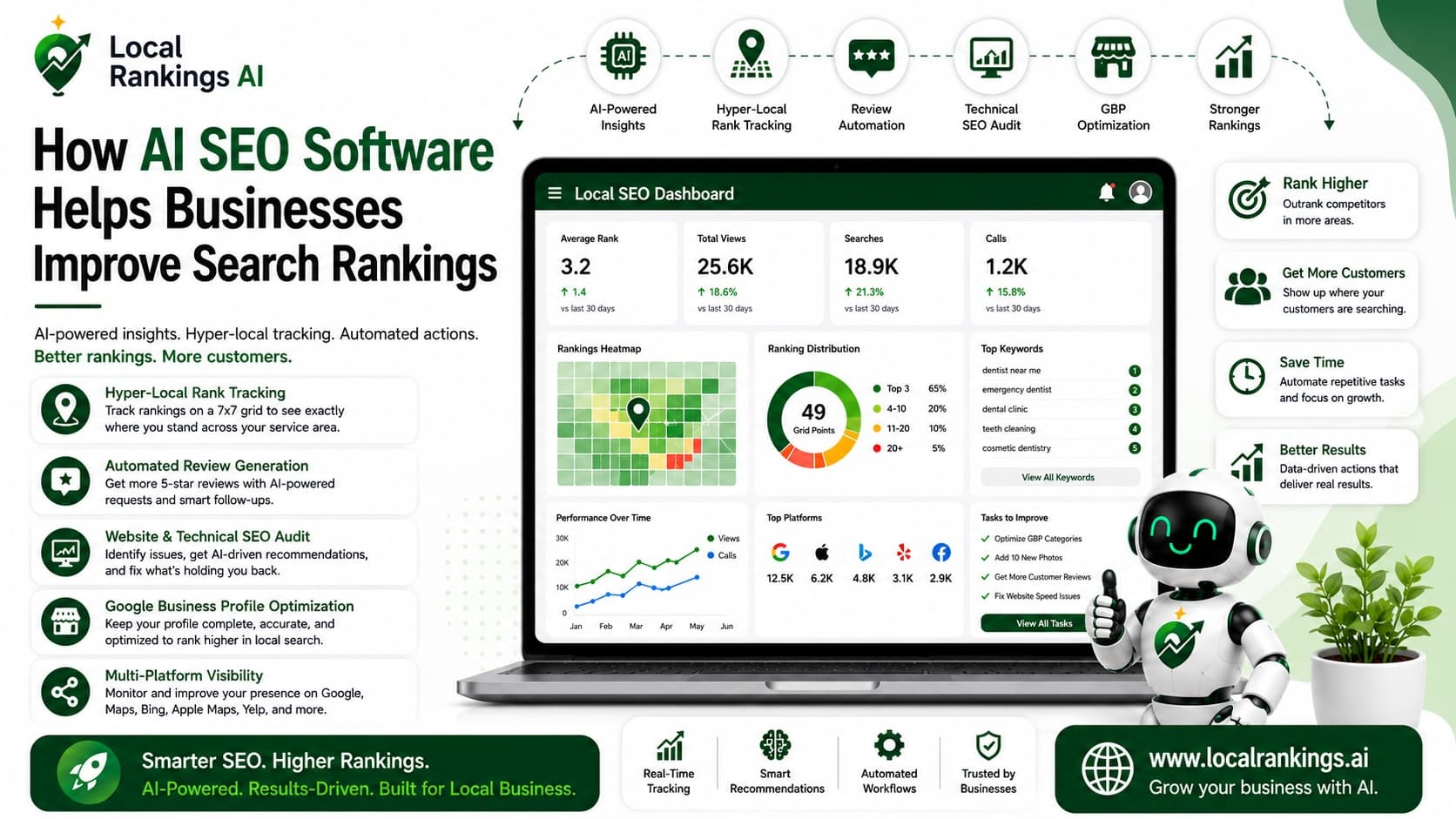
The best platforms treat your service area as a grid, not a dot on a map. They track rankings from multiple geographic points, audit your Google Business Profile, manage your review pipeline, and ensure your business information is consistent everywhere it appears online - from Google Maps to Apple Maps to the AI-powered answer engines your customers are increasingly using.
The Six Capabilities That Separate Strong Platforms from Generic Ones
When you're comparing options, these are the features worth examining closely - and the questions worth asking before you commit to any platform.
1. Geo-Grid Rank Tracking
A single ranking position is not a measurement - it's a sample. If your software reports that you rank #3 for "plumber near me," that number reflects your position from one location, usually near your own business address. It tells you nothing about what someone sees when they search from across town.
Geo-grid rank tracking solves this by mapping your rankings from multiple points across your service area simultaneously. A 7×7 grid gives you 49 distinct data points per keyword — a real picture of your local visibility instead of a single misleading snapshot. This matters most when you're trying to expand into new neighborhoods or understand exactly why leads from certain areas have dried up.
Your Google Business Profile is the highest-leverage element of your local search presence. Incomplete categories, missing service areas, no Q&A content, irregular posting - each of these is a quiet ranking suppressor that most businesses aren't aware of until they run a proper audit.
Strong local SEO software doesn't just tell you your profile is "incomplete." It identifies specific gaps, explains why they matter, and prioritizes them by ranking impact. Before making any platform decision, it's worth running a full business profile audit to see exactly what gaps are currently costing you visibility.
3. Review Generation and Reputation Management
Reviews serve two distinct functions that most businesses think about separately but should manage together. First, review volume and quality are direct ranking signals - Google uses them to assess your business's relevance and trustworthiness. Second, reviews influence whether a searcher actually calls you after they find you.
Software that treats review management as an afterthought is optimizing for only half the problem. What you want is a system that makes review generation consistent - not dependent on someone remembering to ask. If you're currently relying on manual follow-ups, automating your review generation is one of the fastest ways to close the gap with competitors who are outranking you on trust signals alone.
4. AI Search and Answer Engine Optimization (AEO)
This is the capability most platforms haven't caught up on yet, and it's the one that will matter most over the next two to three years. A growing portion of local search now happens through AI-powered answer engines - and the businesses that appear in those answers aren't selected the same way Google's local pack results are.
AI answer engines pull from structured, consistent, authoritative sources. Your business name, address, phone number, categories, service descriptions, and citations all need to be formatted and distributed in ways these systems can parse and trust. Understanding which platforms your customers are actually searching on - and whether your presence is optimized for each - is no longer optional.
5. Multi-Platform Presence Management
Google dominates local search, but it doesn't own it. Bing Maps, Apple Maps, Yelp, and Facebook all factor into your overall local visibility - and inconsistent business information across these platforms creates credibility problems that drag your Google rankings down too, even when your GBP looks solid.
Look for software that manages your citations and business listings from a single interface. Manual updating across platforms is error-prone and time-consuming. If your listings are inconsistent across directories, cleaning up your directory presence is foundational work that every other optimization depends on.
6. Reporting That Points to Action
There's a meaningful difference between a platform that shows you data and one that tells you what to do with it. Many local SEO tools generate polished reports that leave clients nodding along without understanding what changed, why it changed, or what to prioritize next.
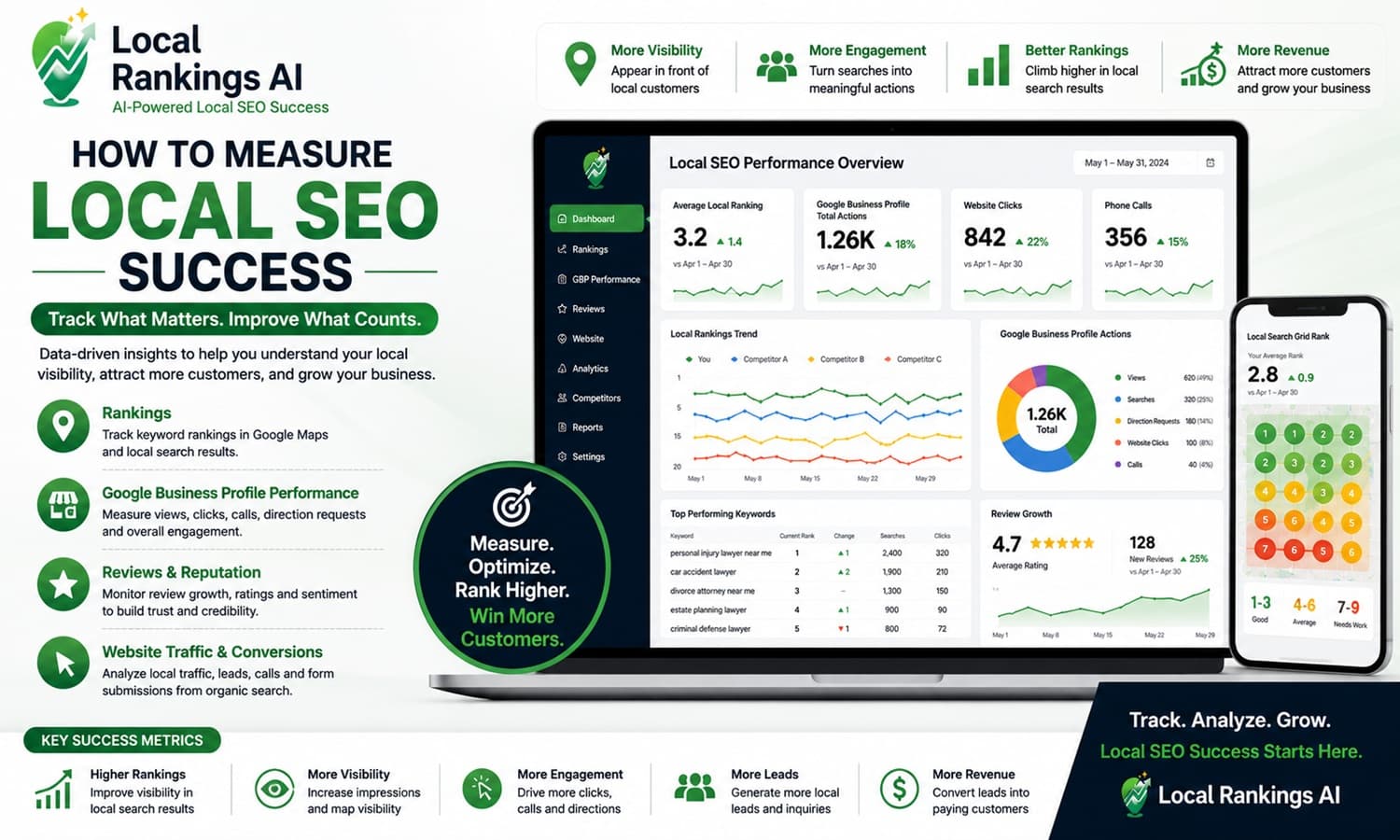
The reporting layer should connect every metric to a decision. Visibility improvements should tie back to specific actions that drove them. Declining rankings should surface recommended fixes, not just red arrows. Seeing what clear, client-ready reporting looks like before you commit to a platform is worth the extra step - it tells you a lot about how the team thinks about accountability.
Self-Service or Managed: Choosing the Right Delivery Model
Beyond features, one of the most practical decisions you'll make is whether you want software you run yourself or a platform that includes hands-on management.
Run it yourself — Full access to rank tracking, audits, review tools, and reporting. Best for agencies, consultants, or business owners who want direct control and have the bandwidth to act on what the data shows consistently.
Let a team handle it — Done-for-you setup, ongoing optimization, review management, and monthly reporting. Best for businesses that want results without the internal overhead of managing it week to week.
The right answer depends entirely on your internal capacity. What matters most is choosing a platform that supports both paths - so if your situation changes, you're not rebuilding from scratch elsewhere. If you'd rather hand this off entirely, you can explore done-for-you local SEO management and see exactly what that includes.
Red Flags Worth Watching for in Any Local SEO Platform
The market is crowded, and the promises often outpace the delivery. Here are the warning signs that a platform will underperform:
Single-point rank reporting. If the platform shows one ranking position per keyword without geographic context, the data is structurally incomplete. You're seeing a fraction of your actual visibility.
No GBP integration. A platform that doesn't connect to and actively optimize your Google Business Profile is skipping the highest-impact local ranking factor available.
Reports without recommendations. Data is only useful when it points somewhere. Impressive outputs without prioritized next steps create the feeling of activity without actual results.
No AEO or AI search features. If a platform hasn't addressed AI-powered search, it's already behind on where the market is heading - and so are the clients using it.
Opaque methodology. Be cautious of any platform that can't clearly explain how it collects data, calculates rankings, or determines what to prioritize. If you can't understand the inputs, you can't trust the outputs.
A Practical Framework for Evaluating Platforms Before You Commit
Before choosing any local SEO marketing software, run through this five-step process:
Get your baseline first. Most credible platforms offer a free ranking check. Use it before you evaluate anything else - you need to know your actual starting position across your service area before you can assess whether a tool's recommendations make sense. You can see your rankings for free here with no credit card required.
Run the GBP audit. See what issues the platform surfaces. A good audit identifies things you didn't already know about your profile - not just what you can already see in your Google dashboard. If it only confirms existing knowledge, it's not adding much value.
Ask to see a sample report. Would you be comfortable sharing it with a client or business partner without explanation? If the output requires a 30-minute walkthrough every month, it's built for dashboards - not for decision-making.
Ask about AI search capabilities directly. If the team can't explain how the platform helps your business appear in AI-powered answer results, that's a product gap - not a roadmap item.
Evaluate what happens after data collection. Does the platform guide you toward specific actions, or leave interpretation entirely to you? The action layer is where most platforms fall short.
What Good Local SEO Marketing Software Looks Like in Practice
The clearest way to understand what a strong platform delivers is to look at what the output actually enables.
Take geo-grid rank tracking as an example. When a business first checks their local rankings across their full service area, the heatmap typically reveals something that surprises them: rankings drop off much faster with distance than they assumed. A business that appears at position two near their address might not appear until position fifteen or sixteen a few kilometers away - a visibility loss of over 90 percent across what they considered their core market.
That single data point changes the entire strategic conversation. Instead of asking "how do we improve our ranking," the question becomes "which specific zones are we invisible in, and what's suppressing us there?" which leads to a completely different set of actions.
From that starting point, GBP optimization improves relevance in the zones that matter, review automation builds the trust signals that convert searchers into callers, and website enhancements make sure the traffic you earn doesn't leave without contacting you. Each layer compounds the one before it.
Conclusion
The businesses that outrank their competitors in local search aren't necessarily the ones with the biggest budgets. They're the ones with the clearest picture of where they're actually visible - and a systematic way to close the gaps they find.
Good local SEO marketing software gives you both. It shows you the truth about your service area coverage. It tells you what's suppressing your rankings and in which specific locations. It automates the parts of local SEO that should be consistent but rarely are. And it produces reporting that connects what you did to what changed.