How AI SEO Software Helps Businesses Improve Search Rankings
AI SEO software helps businesses improve search rankings through automated optimization, keyword insights, content analysis, and data-driven SEO strategies.
June 21, 202610 min read
AI SEO software helps businesses improve search rankings through automated optimization, keyword insights, content analysis, and data-driven SEO strategies.
Let's start with something most SEO agencies won't tell you.
That number you see when you Google your own business? It's probably not what your customers see. The person searching "dentist near me" from two miles away gets a different result. So does the one searching from across town. And the one asking ChatGPT for a recommendation in your city.
You might be ranking #1 at your front door and #15 everywhere else. You'd never know - because traditional SEO tools were never built to show you.
That's the problem AI SEO software actually solves.
Why Local Businesses Keep Getting SEO Wrong
A local business owner in any service industry — plumbing, dental, legal, landscaping, home repair — typically does the same things when they "invest in SEO":
They set up a Google Business Profile. They add keywords to their website. They collect a few reviews. They check their ranking once in a while.
None of that is wrong. But it's incomplete. And the gap between "technically doing SEO" and "actually ranking where customers search" is where most local businesses silently lose.
Here's why: local search is not a single result. It's a constantly shifting map of results that changes based on where the searcher is, what device they're on, what time they're searching, and which platform they're using. Google, Bing, Apple Maps, ChatGPT, Yelp — each one has its own algorithm. Each one surfaces different businesses for the same query.
The question isn't just "do I rank?" It's "where do I rank, on which platforms, in which parts of my service area — and who's outranking me right now?"
AI SEO software is the first category of tools that can actually answer that question.
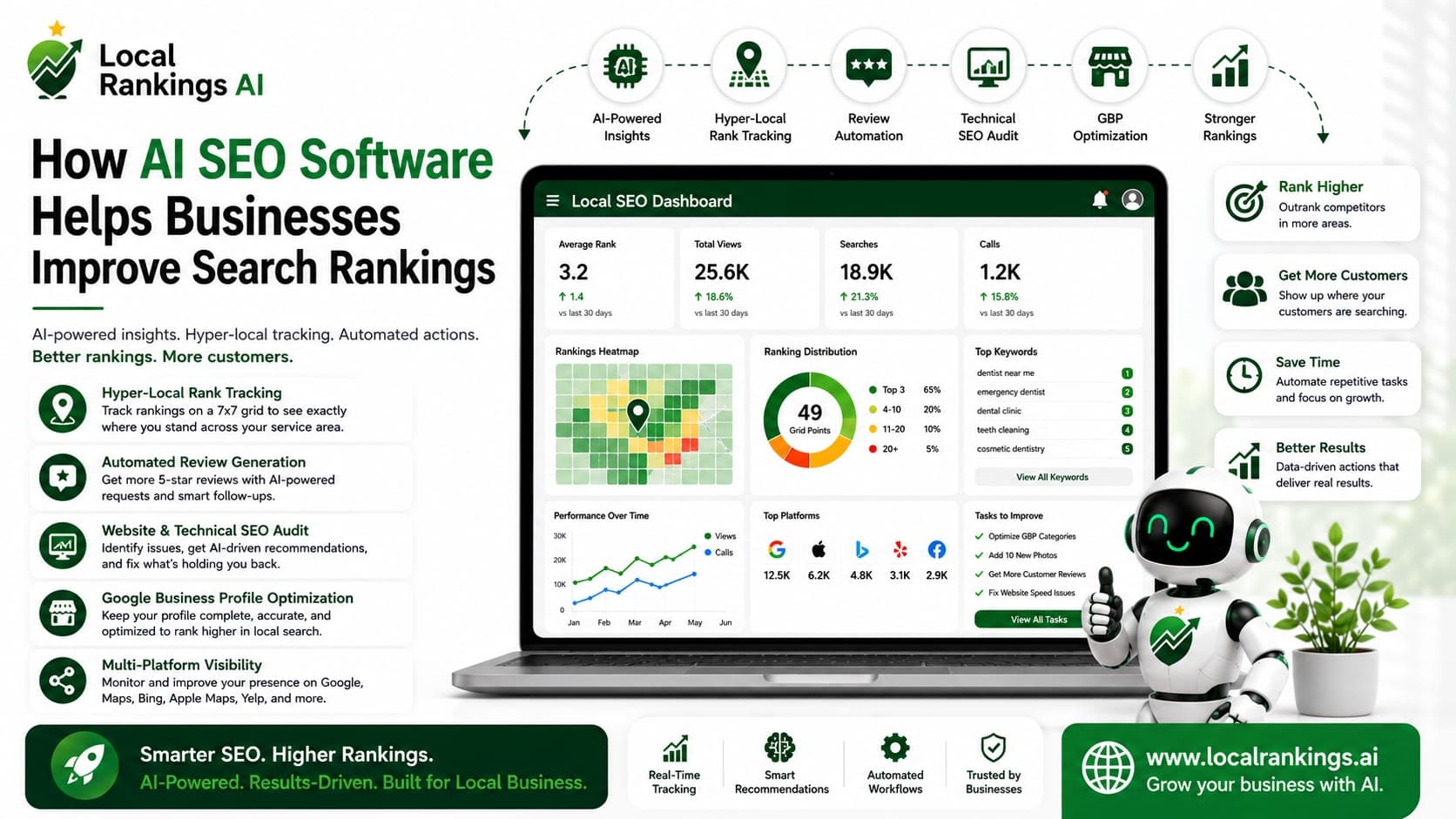
The geo-rank heatmap inside Local Rankings AI maps your visibility across a 7×7 grid — 49 distinct location points across your service area — updated in real time. You see your rankings color-coded on a map: where you're in the top 3, where you drop off, where competitors have claimed territory you're not even aware of.
This changes everything about how you prioritize your SEO work. Instead of trying to improve a vague average position, you're looking at a visual map and saying: "I rank well in these three neighborhoods, I'm invisible in this part of town, and this competitor is outranking me on the east side." That's an actionable insight. An average position is just a number.
Most local business websites have the same set of problems: slow load times, missing schema markup, poor mobile performance, local SEO metadata that's either missing or formatted incorrectly. These aren't dramatic problems. They're quiet ones — the kind that cost you rankings every single day without ever triggering an obvious error.
Website enhancement tools in Local Rankings AI run a complete AI-powered audit of your site — speed, Core Web Vitals, mobile usability, local signals, structured data — and surface the specific fixes most likely to move your rankings. Plain-English instructions. Prioritized by impact. No developer required for most of it.
One business owner on the platform described jumping from #8 to #3 in Google Maps within a week of implementing the audit fixes. That's not a testimonial about AI magic. That's what happens when technical problems that were quietly suppressing your rankings get fixed.
Reviews aren't just trust signals anymore. They're a direct ranking input for Google's local algorithm, for AI Overviews, and for AI assistants that recommend local businesses by name. Google rewards businesses with higher review velocity, better sentiment, and faster response times — and it measures all three continuously.
Most local businesses get reviews sporadically. A happy customer leaves one without being asked. A frustrated one leaves one when they're upset. There's no system, no consistency, and no way to build the kind of review momentum the algorithm rewards.
AI Review Automation changes this by making review generation systematic. Branded review requests go out automatically after purchases, appointments, or service calls. AI-written replies go back instantly — personalized, professional, matching your brand voice. Negative reviews get flagged for fast handling before they compound.
The result isn't just more stars. It's the kind of consistent review velocity that Google and AI platforms treat as a signal of a credible, active, trustworthy business — which directly influences your rankings.
The Platforms Driving Local Discovery in 2026
Here's something most local SEO conversations undercount: Google is not the only platform that matters anymore.
Customers are finding local businesses through:
Google Search and Maps — still the highest-volume channel, but increasingly shaped by AI Overviews that surface answers before organic results
Apple Maps and Siri — critical for iPhone users searching by voice, which now accounts for a significant share of local queries
Bing and Microsoft Copilot — growing share especially on Windows devices and in professional settings
ChatGPT — used directly for local recommendations by a growing segment of users with browse enabled
Yelp — still the default for restaurant, home service, and professional service categories in most markets
Facebook — local business recommendations remain a significant discovery channel
Each platform pulls from overlapping signals: consistent business information across directories, review volume and recency, active profiles, and structured website content. A business that's optimized for one typically performs better across all of them — because the underlying signals are the same.
Local Rankings AI tracks your visibility across all of these platforms from one dashboard, so you're not guessing which ones are driving your customers and which ones have gaps worth fixing.
Google's local algorithm has always evaluated businesses on three dimensions. AI SEO software is what finally makes all three measurable and improvable simultaneously.
Relevance — Does your business match what the searcher is looking for? This is shaped by your Google Business Profile categories, the keywords in your website content, and how specifically your content addresses local search intent. AI-powered auditing identifies mismatches between how you describe your business and how customers actually search for it.
Proximity — How close is your business to the searcher? This is the variable traditional rank tracking ignores entirely. Geo-rank heatmaps make proximity-based ranking visible — showing you the exact radius within which you're competitive and where you fade.
Prominence — How credible and well-known is your business online? This is the sum of your reviews, citations, backlinks, directory listings, and overall completeness across platforms. AI tools surface specific gaps in prominence — a missing directory listing, an inconsistent NAP, a review gap — that are suppressing your visibility in ways you'd never identify manually.
Working all three simultaneously is what separates businesses that consistently rank well from those that do everything "right" and still wonder why they're not on the first page.
A Realistic Picture of What Improves and When
There's a version of this conversation that promises overnight results. This isn't that.
Local search rankings improve when you fix real problems — technical issues, profile gaps, review velocity, content relevance — and maintain that improvement consistently over time. For most local businesses, the timeline looks something like this:
Days 1–30: Technical fixes, profile optimization, and review automation setup create measurable improvements in site performance and the start of a consistent review flow.
Days 30–60: Review velocity starts building. Profile completeness improves. Geo-rank data shows initial movement in your most competitive locations.
Days 60–90+: Compounding improvements. Review signals strengthen. Technical performance continues to support rankings. Visibility expands across the service area.
The businesses that rank at the top of local search in competitive markets didn't get there with one tactic. They built a system - and they ran it consistently.
Self-Serve or Done-For-You
Local Rankings AI offers both paths, and the right choice depends entirely on your situation.
If you have someone on your team who can spend a few hours a week acting on data and implementing recommendations, the self-serve platform gives you everything you need: geo-rank tracking, automated reviews, website auditing, profile monitoring, and guided recommendations. You stay in control.
If local search is critical to your business and you genuinely don't have the bandwidth to manage it as an ongoing system, the done-for-you service handles everything - setup, optimization, review generation, monitoring, and ongoing improvements. You get the results without managing the process.
Neither is universally better. But both are better than treating local SEO as something you do once and forget about.
Conclusion
AI SEO software doesn't make local search easier. What it does is make it honest — showing you where you actually rank instead of where you think you rank, and telling you specifically what to fix instead of leaving you to guess.
For local businesses, that honesty is everything. Rankings that shift block by block, platforms that each have their own signals, review velocity that compounds over time — these aren't abstract SEO concepts. They're the mechanisms that determine whether a customer a mile away finds you or your competitor.
Local Rankings AI was built specifically to make those mechanisms visible, manageable, and improvable — for any local business, in any market, with or without an SEO team behind them.
Sign Up