Choosing a local SEO provider is not simply about finding an agency that can improve rankings. The more important question is whether the provider can show where your business is visible, where it is losing ground, what is causing those gaps, and what needs to happen next.
That is where Local Rankings AI takes a different approach.
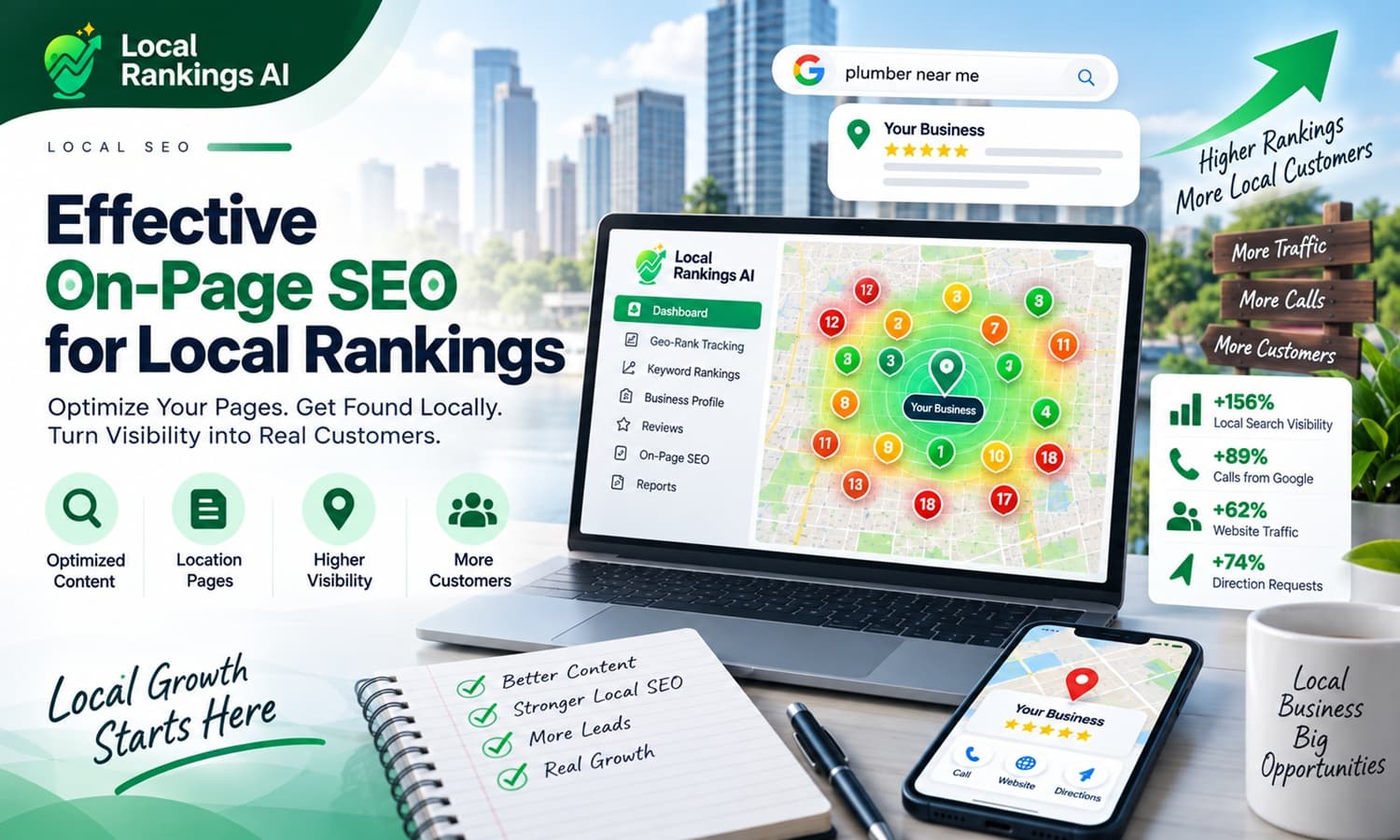
Instead of relying on a single citywide ranking or periodic SEO report, Local Rankings AI uses street-level geo-rank tracking to measure visibility across the areas your customers actually search from. The platform combines this geographic data with AI-powered recommendations, Google Business Profile optimization, review automation, website improvements, multi-platform visibility, and reporting.
The result is a local SEO system built around visibility, action, and measurable progress—not vague ranking promises.
Key Takeaways
Street-level geo-rank tracking shows how your business performs across different neighborhoods and locations.
AI-powered recommendations turn ranking data into prioritized actions instead of leaving you with another report to interpret.
Multi-platform optimization extends visibility beyond Google to platforms such as Bing, Apple, Yelp, and AI-driven search.
Review automation and profile optimization address important parts of local search visibility beyond website content.
Self-service and managed SEO options allow businesses to choose between direct control and hands-off support.
Client-ready reporting makes it easier to demonstrate progress, identify opportunities, and connect SEO activity with business growth.
What Makes Precision Geo-Rank Tracking Different?
One of the biggest differences between Local Rankings AI and conventional local SEO approaches is how visibility is measured.
A traditional rank check might tell you that your business ranks #3 for a keyword. That sounds impressive—but where was that search performed?
Your business could rank #3 near its location while ranking #10, #15, or even outside the top results a few miles away.
That matters because local search rankings are heavily influenced by the searcher's location.
Local Rankings AI addresses this problem with geo-grid and street-level ranking data, allowing businesses to see how visibility changes across their actual service area.
Instead of asking:
"What is my local ranking?"
the better question becomes:
"Where am I ranking, where am I not ranking, and what can I do about it?"
This distinction is fundamental.
A precision geo-rank grid can reveal:
Neighborhoods where your visibility is strongest
Areas where competitors consistently outrank you
Locations where your rankings decline
Geographic pockets that need additional optimization
Changes in visibility over time
For businesses serving large geographic areas, this level of detail can be far more useful than a single citywide ranking number.
Why Does Street-Level Ranking Data Matter for Local Businesses?
Local customers do not all search from the same place.
Someone searching for "plumber near me" from one neighborhood may receive very different results from someone searching for the same service several miles away.
This means local visibility is geographic.
A business that looks highly visible from its own office may still have significant ranking gaps throughout its wider service area.
Street-level ranking data exposes those gaps.
Instead of relying on assumptions, businesses can identify areas where visibility is underperforming and prioritize the work that has the greatest potential impact.
That approach is particularly valuable for service-area businesses, multi-location companies, franchises, and businesses competing across larger metropolitan markets.
How Does Full-Service Optimization Set Local Rankings AI Apart?
Rank tracking alone does not improve rankings.
It tells you what is happening. The next step is determining what needs to change.
That is why Local Rankings AI combines visibility data with a broader local SEO workflow.
The platform brings together:
Local rank tracking
Google Business Profile optimization
Website optimization
Review automation
Business listing management
Multi-platform visibility
AI-powered recommendations
Performance reporting
This creates a connected approach rather than treating each part of local SEO as a separate task.
For example, if your rankings are weak in a particular geographic area, the answer may not simply be "build more links." The underlying opportunity could involve your Google Business Profile, reviews, website relevance, business information, or overall local presence.
The purpose of connecting these elements is to make it easier to identify the most relevant next action.
Reviews influence both customer trust and the overall strength of your local presence.
The challenge is consistency. Businesses need a repeatable process for requesting reviews, monitoring feedback, and responding appropriately.
Local Rankings AI's Review Automation is designed to automate review requests, AI-assisted responses, alerts, and reputation monitoring.
3. Website Optimization
Your website needs to support the same local signals as your business profile.
That includes improving local relevance, website health, page experience, content, and conversion opportunities.
4. Business Listing Consistency
Inaccurate or inconsistent business information across directories can create unnecessary friction for both customers and search engines.
Keeping important business information synchronized across relevant platforms helps create a more consistent local presence.
5. Multi-Platform Visibility
Local discovery no longer happens exclusively on Google.
Depending on the business and audience, customers may discover companies through Bing, Apple Maps, Yelp, Facebook, and increasingly AI-powered search experiences.
Local Rankings AI is designed to bring these visibility channels into a broader local growth workflow.
Google remains a critical local discovery channel, but it is not the only one.
Customers may use:
Google Search and Maps
Bing
Apple Maps
Yelp
Facebook
AI-powered search and recommendation platforms
This creates a broader challenge for local businesses: your online presence needs to remain accurate and discoverable wherever customers look for you.
A business that performs well on Google but has outdated information elsewhere may still be creating unnecessary friction for potential customers.
Local Rankings AI approaches this as a connected visibility problem rather than a Google-only problem.
The platform's current workflow supports visibility and local growth across major discovery platforms, with rankings, reviews, listings, and optimization managed through a centralized system.
Self-Service vs. Managed Local SEO: Which Is Right for Your Business?
Another important differentiator is flexibility.
Not every business wants the same level of SEO support.
Some marketing teams want direct access to data and the ability to execute optimization themselves.
Others would rather have an experienced team handle the ongoing work.
Local Rankings AI provides both approaches.
Self-Service Local SEO
Self-service is well suited to businesses or marketing teams that want:
Direct dashboard access
Visibility into local rankings
Control over optimization
Actionable recommendations
The ability to execute changes internally
This approach provides greater hands-on control.
Managed Local SEO
Managed support is better suited to businesses that want to delegate execution.
The team can handle activities such as:
Local SEO setup
Optimization
Ranking monitoring
Review management
Website improvements
Business profile optimization
Ongoing recommendations
This can be particularly useful for owners and small marketing teams that do not have the time or resources to manage local SEO themselves.
The key difference is that businesses do not have to choose a platform that forces them into one operating model.
Which Produces Better Results: Self-Service or Managed SEO?
There is no universal answer.
The better option depends primarily on internal resources, expertise, and execution capacity.
A business with an experienced marketing team may prefer self-service because it can quickly act on ranking insights.
A business owner who is already managing operations, employees, customers, and sales may benefit more from managed support.
The important distinction is that the underlying visibility data remains useful in either model.
Self-service gives you control.
Managed SEO gives you execution support.
Both are designed around the same objective: improving visibility where your customers are actually searching.
How Do You Measure Whether Local SEO Is Actually Working?
Higher rankings are useful, but rankings should not be treated as the only measure of success.
A stronger local SEO measurement framework looks at multiple signals, including:
Street-level ranking improvements
Visibility across the service area
Google Business Profile health
Review volume and engagement
Website traffic
Calls and inquiries
Direction requests
Website conversions
Visibility across important search platforms
Progress over time
This is where detailed reporting becomes important.
Instead of presenting disconnected SEO metrics, businesses should be able to understand what changed, where it changed, why it matters, and what should happen next.
Final Thoughts: Local SEO Should Be Measurable, Geographic, and Actionable
The biggest difference between Local Rankings AI and a conventional local SEO approach is not simply the number of features available.
It is the way those features work together.
Local SEO visibility is not one number. It is a geographic footprint.
A business may dominate searches around its location while remaining nearly invisible in other parts of its service area. Without location-specific data, those gaps are easy to miss.
Local Rankings AI combines street-level geo-rank tracking with AI-driven recommendations, business profile optimization, review automation, website improvements, multi-platform visibility, and flexible self-service or managed support.
That creates a more practical way to manage local search:
See where you stand. Identify where visibility is weak. Prioritize what needs fixing. Take action. Measure the change.
For businesses that want to stop guessing about local visibility and start making decisions based on actual search data, that is the real difference.
See where your business ranks across your service area with Local Rankings AI and turn local search visibility into a measurable growth strategy.

.png&w=3840&q=75)