What Is Geo-Rank Tracking and Why Does It Matter for Local SEO?
Learn what geo-rank tracking is, how it measures local search rankings by location, and why it's essential for improving visibility, attracting nearby customers, and boosting local SEO.
If you've ever searched your own business name and felt relieved to see yourself sitting at #1, here's something worth knowing: that's not what most of your customers actually see. Search a few streets away - sometimes even one block away - and your ranking can look completely different. This single blind spot is one of the biggest reasons local businesses lose customers without ever realizing it, and it's exactly what geo-rank tracking is designed to fix.
As more businesses adopt an AI based SEO platform to manage their visibility, geo-rank tracking has become one of the most requested features - and for good reason. Let's break down what it actually means and why it matters so much for local search.
Schedule Demo
What Is Geo-Rank Tracking? A Local SEO Guide Using an AI Based SEO Platform
What Is Geo-Rank Tracking?
Geo-rank tracking is the process of checking your search ranking from multiple physical points across your service area, instead of relying on a single search from one location.
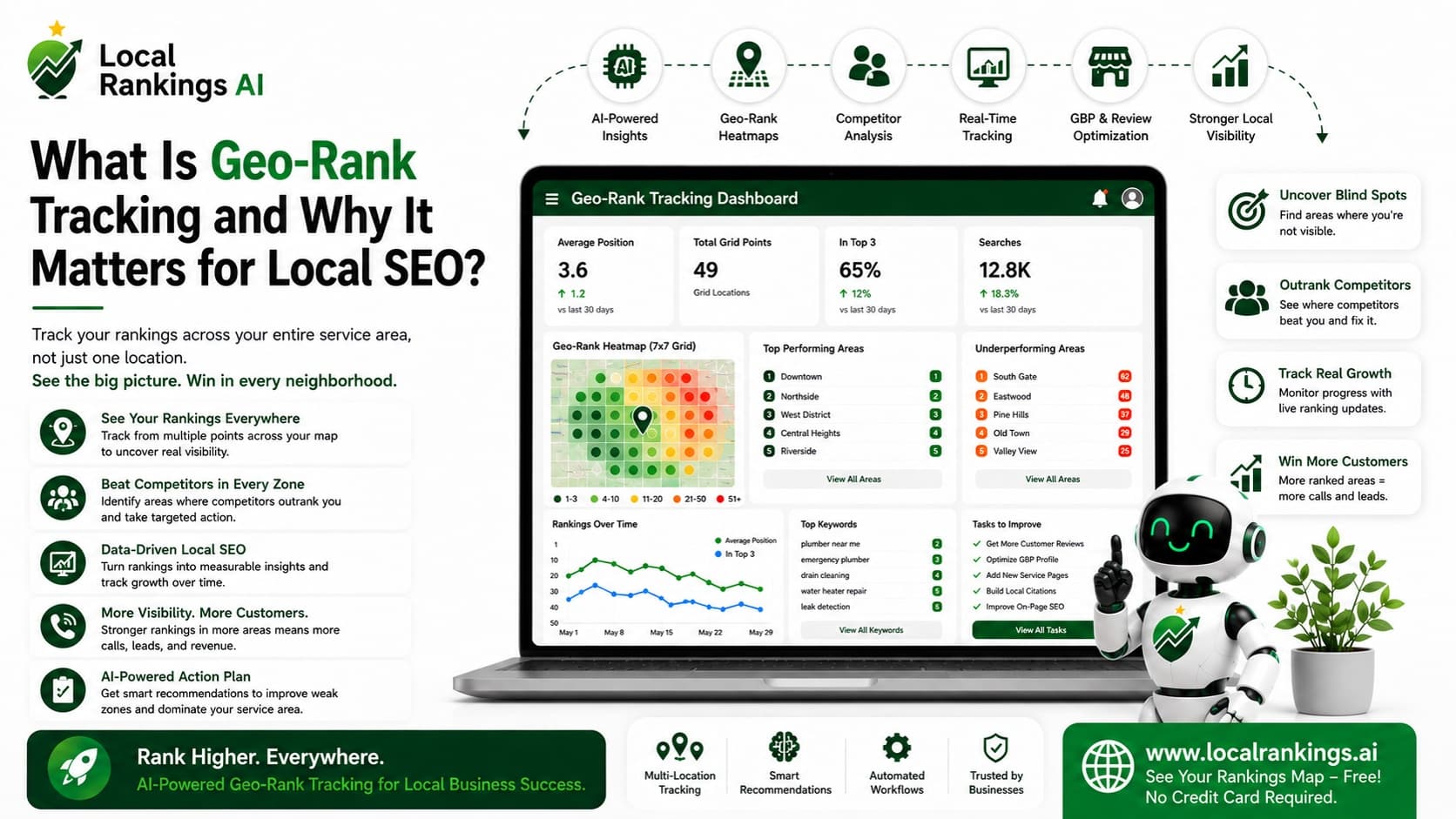
Picture a grid placed over a map of your city or town. Rather than asking "Where do I rank?", geo-rank tracking asks a more useful question: "Where do I rank at every point on this grid?" The result is usually shown as a heatmap, with each zone color-coded based on how visible your business is from that exact spot.
A typical grid might cover a 7x7 area, generating 49 individual rank points across your service zone. Each one reflects a real search performed from that location, not an estimate. Running this manually - and keeping it updated - simply isn't realistic for a business owner. This is exactly the kind of repetitive, data-heavy task an AI based SEO platform is built to automate.
Why Checking One Ranking Isn't Enough
Most business owners check rankings the same way: open Google, search their main keyword, see where they land, and assume that result applies everywhere. The problem is that Google's local results are heavily personalized based on the searcher's exact location at the time of the search.
Here's what that looks like in the real world: a plumbing business might rank #1 right at its own address for "plumber near me." But move just one kilometer away, and that same business could fall to position #15 - a visibility loss of more than 90%. The business owner has no idea this gap exists, simply because they only ever check from one place: their own front door, where they're naturally going to rank well.
Multiply that across an entire service area, and it becomes clear how much visibility — and how many potential customers - can disappear in zones a business never thought to check.