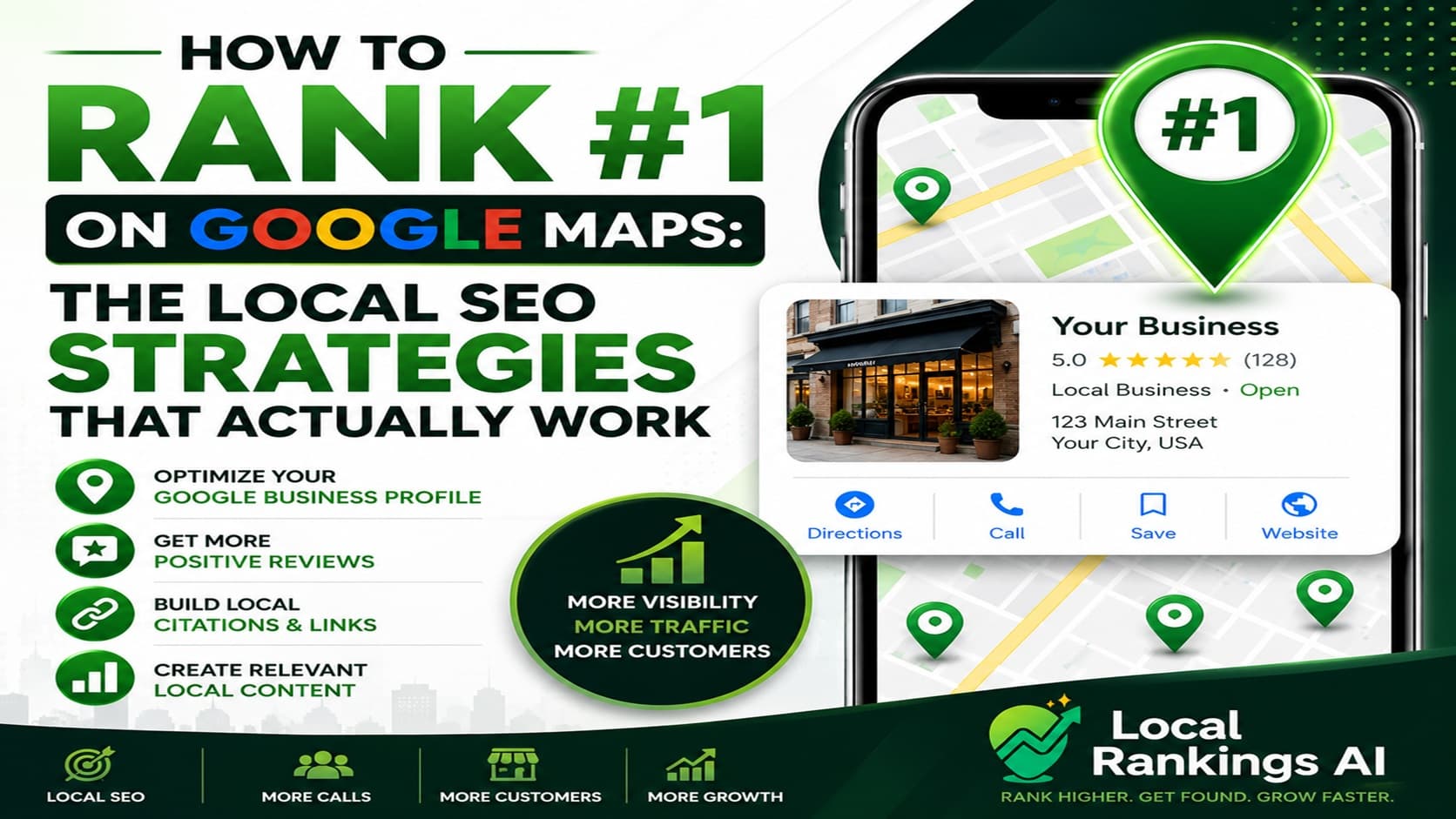
Ranking #1 on Google Maps is not a matter of luck — it is the result of deliberate, consistent local SEO execution. Businesses that claim and fully optimize their Google Business Profile, build accurate citations, earn genuine reviews, and target hyper-local keywords are the ones that dominate the local pack and convert searchers into customers.
The local pack sits at the very top of Google search results. Businesses that appear there capture a disproportionate share of clicks from users with immediate purchase intent. Getting there requires mastering three core signals Google evaluates: proximity, relevance, and trust.
Local Rankings AI delivers the geo-rank grid tracking, AI review automation, and business profile audits that show exactly where competitors are taking over — so businesses can act on real data rather than assumptions. Explore Local Rankings AI to see where your business stands right now.
Key Takeaways
The Google Maps local pack appears above all organic results and drives the highest share of clicks from ready-to-buy customers.
Google ranks local businesses on three signals: proximity to the searcher, relevance to the search query, and trust built through reviews and consistent information.
Businesses with physical locations or defined service areas benefit most from a focused local SEO strategy.
Consistent, data-driven optimization outperforms larger competitors that rely on budget alone.
What prerequisites do you need before starting?
Ranking on Google Maps starts before any optimization tactic is applied. Without the right foundation in place, even well-executed strategies produce inconsistent results.
Before executing any optimization steps, businesses must confirm three foundational prerequisites:
A verified business listing — Claim and verify the business on Google and all other relevant platforms before making any changes.
Accurate business information — Confirm that the business name, address, and phone number are identical across every directory and citation source.
A baseline rankings snapshot — Know exactly where the business ranks today before investing effort in improvement.
Why does appearing in the local map pack matter?
The local map pack sits above all organic search results, making it the first element most users see. Businesses listed in the map pack receive direct calls, direction requests, and website visits at a significantly higher rate than standard organic listings — because the customer's intent is immediate.
How can businesses identify where customers cannot find them?
Local Rankings AI provides a free local rankings map that shows precisely where a business ranks across its service area and pinpoints the exact gaps where customers are finding competitors instead. Businesses that start with this data enter the optimization process with a clear strategic advantage — acting on evidence rather than assumption.
How do you execute the core optimization steps?
A fully optimized Google Business Profile is the single most important asset in any local SEO strategy. It is the foundational signal that tells Google what the business does, where it operates, and why it deserves to rank. Businesses that leave this profile incomplete or inconsistent hand an immediate advantage to every competitor that does not.
Prerequisites: Confirm the business has claimed and verified its Google Business Profile before starting the steps below.
Audit the business profile. Complete every field — business name, primary category, hours, photos, and service areas. Use a structured business profile audit to identify gaps across Google, Bing, Apple, Yelp, and other platforms simultaneously.
Optimize the website for local relevance. Align on-page content with the service areas and categories listed in the business profile. A consistent match between the website and the profile reinforces the relevance signals Google uses to rank local results.
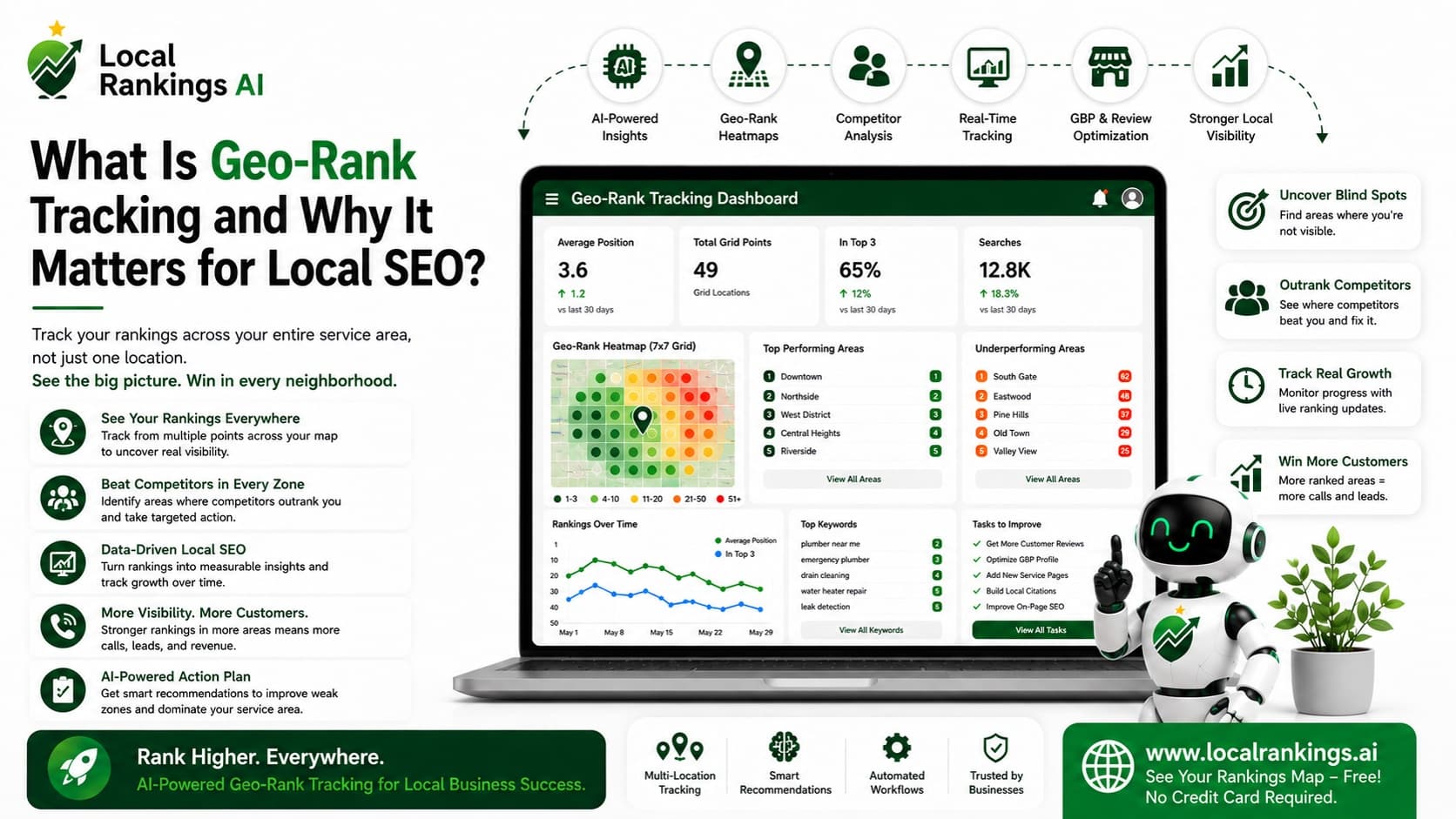
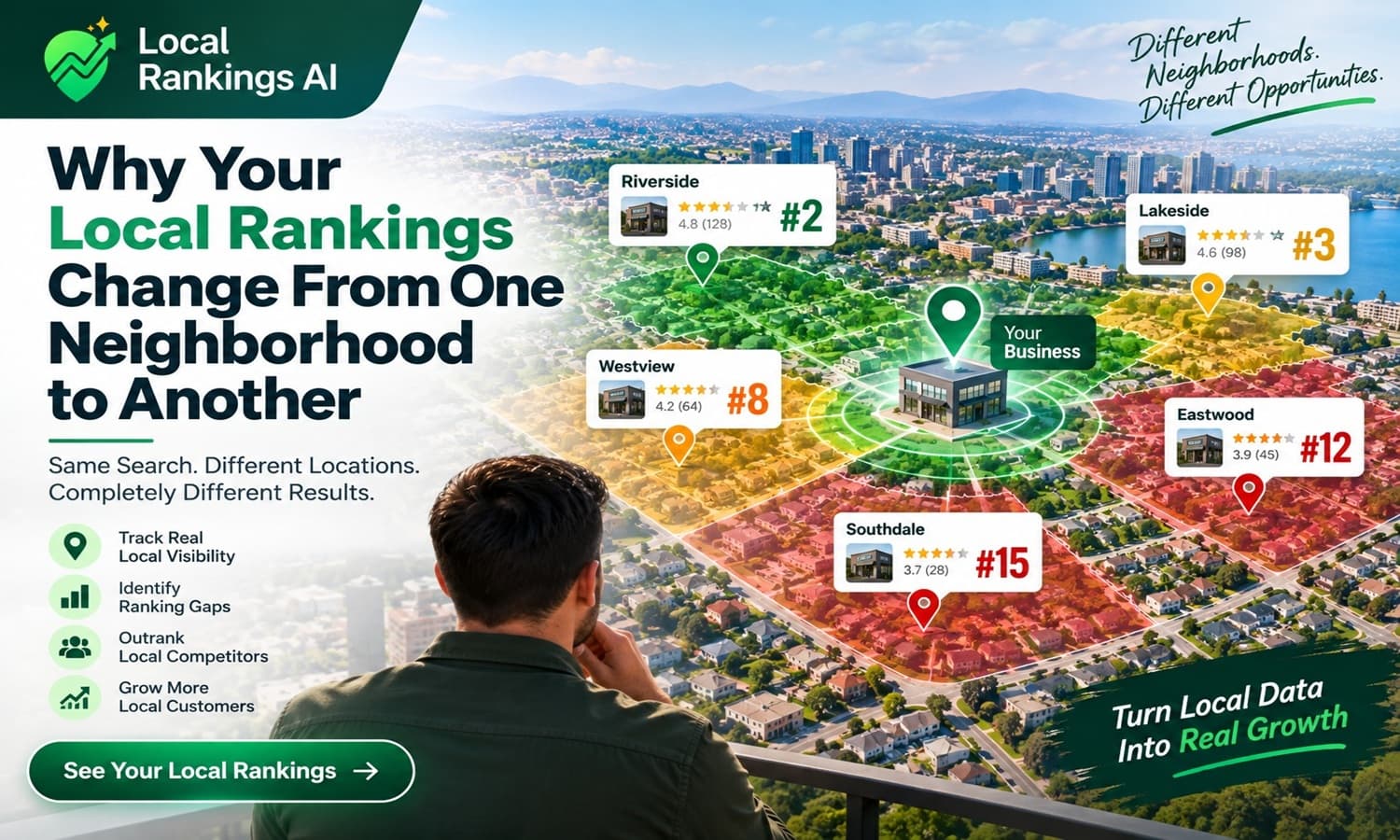
Map rankings at street level. Run a geo-rank grid to see exactly where the business appears — and where competitors take over. Rankings shift block by block, so what a business owner sees when searching their own name is not what nearby customers see.
Execute AI-generated action tasks. Review a prioritized list of changes most likely to improve rankings. AI-powered action tasks remove guesswork by directing effort toward the moves with the highest measurable impact.
Automate review collection. Activate review automation to build a consistent stream of fresh ratings, reinforcing trust signals across all platforms.
Why does street-level ranking data matter?
A single city-wide ranking number hides the full picture. Geo-rank grids reveal the specific blocks where visibility drops, letting businesses target underperforming zones with precision rather than broad, unfocused effort.
How do actionable AI tasks speed up the optimization process?
AI-generated tasks replace manual guesswork with a prioritized checklist tied to real ranking data. Businesses act on the changes most likely to move the needle — faster and with measurable direction.
How do you track results and fix common mistakes?
Tracking local search performance requires geo-specific data, not broad keyword rankings. A precision geo-rank grid lets businesses monitor their positions across an entire service area and identify underperforming zones before those gaps cost leads.
What is a geo-rank grid and why does it matter?
A geo-rank grid maps ranking positions at the street level, revealing exactly where a business loses visibility to competitors. Without this level of granularity, businesses make optimization decisions based on incomplete data — fixing the wrong problems while real gaps go unaddressed.
How do businesses act on ranking data efficiently?
Local Rankings AI offers two distinct paths for acting on ranking data:
Self-managed optimization — Businesses access the platform directly, review geo-rank data, and execute AI-recommended tasks independently.
Fully managed service — The Local Rankings AI team handles ongoing monitoring and optimization on the business's behalf.
Both paths produce the same outcome: documented, measurable ranking improvements. Local Rankings AI converts those wins into clean, client-ready documentation, giving businesses and agencies a straightforward way to demonstrate progress and prove the value of their local SEO investment to stakeholders.
Frequently Asked Questions
Conclusion
Ranking #1 on Google Maps is not a one-time task — it is an ongoing commitment to the three signals Google values most: proximity, relevance, and trust. Businesses that verify their foundation, fully optimize their Google Business Profile, track rankings at the street level, and act on real data consistently are the ones that claim and hold the top spot in the local pack.
The strategies covered in this guide work because they are built on how Google actually evaluates local businesses — not on shortcuts or guesswork. A verified listing, accurate citations, genuine reviews, and hyper-local keyword alignment compound over time, turning a business that is invisible in local search into the first result customers see when they are ready to act.
Local Rankings AI provides the geo-rank grid tracking, AI-powered review automation, and business profile audits that make every step measurable. Businesses that start with data — knowing exactly where they rank and where competitors are winning — optimize with precision instead of hope. That is the difference between chasing rankings and owning them.