Why Your Local Rankings Change From One Neighborhood to Another
Local rankings can change dramatically from one neighborhood to another. Learn how distance, relevance, competition, prominence, and geographic search behavior influence Google Maps visibility, and how geo grid tracking helps identify local ranking gaps and opportunities.
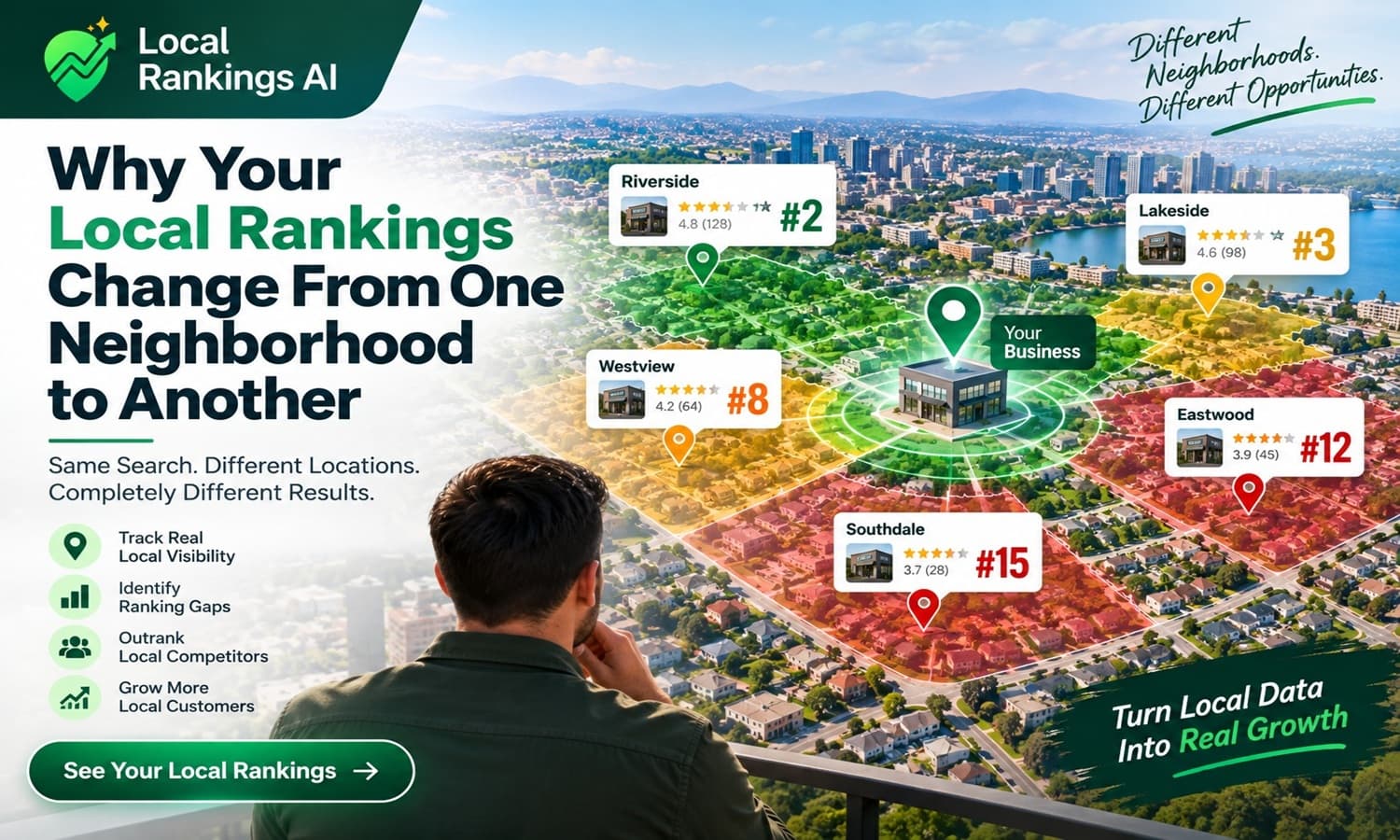
Proximity to the searcher drives most neighborhood-level ranking shifts in Google's Map Pack. A business two miles away often outranks a competitor with stronger reviews and backlinks, purely because Google favors the nearer option. Local Ranking Grid reports expose these street-level variations, revealing where visibility drops even a few blocks from a business's core service area.
Key Takeaways
- Google heavily weights proximity to the searcher, causing rankings to shift dramatically across neighborhoods and service areas.
- Street-level geo-rank data reveals underperforming locations where competitors outrank you despite stronger brand recognition or reputation.
- Ranking changes occur because search algorithms evaluate distance differently for each neighborhood based on local search intent and competition.
- Precision geo-rank grids identify exact locations where your business loses visibility, enabling targeted optimization to convert local searches into customers.
- Accurate structured data (schema markup) helps Google correctly interpret a business's location, service area, and offerings, strengthening the relevance signals that support consistent local rankings.
Why Do Local Rankings Change By Neighborhood?
Proximity drives most of the swing in why local rankings change by neighborhood. Google weighs how close a searcher stands to a business. That single factor can push a smaller company above a better-known competitor a few blocks away. This is the local SEO proximity factor at work. It explains why the same business can rank first on one street and disappear three streets over.
This unevenness creates google map pack ranking variance that can often go unnoticed by business owners. Problems here tend to fail quietly. A business may assume it serves an entire service area, but proximity can limit visibility in certain neighborhoods.
Why don't businesses notice a local rank drop across city zones?
A local rank drop across city neighborhoods rarely announces itself. Leads stop calling, and prospects go to a competitor the business owner has never even heard of. Most companies don't recognize the problem until customers are already gone.
How can businesses catch neighborhood-level ranking gaps early?
Geo rank grid tracking solves the visibility gap by mapping performance across an entire coverage area, not just one storefront address. Rather than checking a single search result, this method reveals block-by-block strengths and weaknesses.
A precision geo-rank grid gives multi-location brands and local SEO managers a clear view of underperformance, neighborhood by neighborhood:
- Pinpoints zip codes or districts where rankings lag behind the core service area
- Flags neighborhood level local SEO gaps before they cost leads
- Turns scattered ranking data into a single, actionable map
Tracking rankings this way turns a guessing game into a measurable strategy, one that catches drops before they turn into lost revenue.
The Problem With Saying "We Rank #3 in the City"
Consider a remodeling company located in the center of a metropolitan area.
Its owner searches:
"kitchen remodeling company"
from the company's office.
The business appears at position #3.
The owner records that ranking and checks again the following month.
Still #3.
It looks stable.
But imagine customers searching from five different parts of the market:
Search location | Local visibility |
|---|---|
Near business | #3 |
Northwest neighborhood | #6 |
Eastern suburb | #11 |
Southern suburb | #17 |
Outer service area | Not visible in top results |
The company doesn't have a #3 local ranking.
It has a geographic visibility pattern.
That distinction matters because customers don't search from the business owner's office. They search from their homes, workplaces, cars and neighborhoods.
Google's own documentation states that distance is based on how far potential businesses are from the person searching, or from the location specified in the search.
So the first question a local business should ask isn't:
"What position do we rank at?"
It should be:
"Where do we actually have visibility?"
Your Local Ranking Is Better Viewed as a Map Than a Number
Traditional rank tracking often encourages a simple question:
"What is my position?"
Local search requires a different question:
"What is my geographic footprint?"
This is why geo-grid tracking has become useful for local SEO.
Local Rankings AI's existing geo-rank tracking content describes the concept as checking rankings from multiple physical points across a service area and visualizing those results as a geographic heatmap.
The advantage is not simply having more ranking numbers.
It is being able to identify patterns.
For example:
Pattern A: Strong core, weak outer areas
Your visibility may be concentrated around your physical location.
Pattern B: Strong east, weak west
A directional visibility gap deserves investigation.
Pattern C: Strong for one keyword, weak for another
The issue may be service relevance rather than geographic coverage.
Pattern D: Competitor dominates a specific zone
That area may require a closer competitive analysis.
These patterns are far more useful than reporting:
"Average ranking: 7.2."
How Does The Local SEO Proximity Factor Work?
Distance between a searcher's location and a business location is one of the core drivers of Google Map Pack results. Google's local algorithm treats the local SEO proximity factor as one of three core ranking signals, alongside relevance and prominence. That weighting explains why local rankings change by neighborhood even when a business hasn't touched its website or Google Business Profile in months.
Search results shift because Google recalculates proximity for every individual query. A shopper standing two miles from a smaller company can see that business rank above a competitor with a stronger website, deeper backlink profile, and more reviews. Convenience wins the moment when Google judges the nearby option more relevant to that searcher's exact position.
This creates google map pack ranking variance across a single service area. A business owner might rank #1 downtown and disappear from the map pack ten minutes away.
Why Does A Business Rank Differently Just Blocks Away?
Proximity recalculates per search, not per business. Two searchers typing an identical query from different streets can see completely different map pack results. Google measures each query against the searcher's specific coordinates.
Multi-location brands and marketers tracking visibility city-wide need to watch for a local rank drop across city zones that share the same service type. Sit outside a business's strongest radius. Ignoring neighborhood level local SEO performance means missing:
- Underperforming zip codes with high search volume
- Competitor gains in adjacent neighborhoods
- Street-level ranking shifts that never show up in a single averaged report
AI-powered local SEO software addresses this gap by converting visibility data into action, improving rankings street by street through real-time geo-rank data that pinpoints blind spots before they cost customers.
What Causes Google Map Pack Ranking Variance?
Distance between searcher and business location drives most of the shift seen across a service area. Google tries to show customers the kind of nearby business they'd like to visit, which means two locations searching the same term can see completely different map results. That single mechanism explains why local rankings change by neighborhood more than website quality, review count, or backlink profile.
Several signals combine to create this pattern:
- Local SEO proximity factor — distance from searcher to listing, weighted alongside relevance and prominence
- Business profile completeness, which varies in strength depending on category and service area coverage
- Search intent differences between dense urban zip codes and surrounding suburbs
Why does a single ranking number hide the real story?
One position score rarely reflects what's happening across an entire territory. A good rank tracking report holds far more useful information than a lone number. Most business owners glance at that figure and close the tab within seconds. That habit buries the local rank drop across city zones sitting just beneath the summary score, and nothing changes because nobody looks closer.
How does street-level tracking expose hidden variance?
Geo rank grid tracking plots performance across dozens of points inside a service area, not just one central address. This method exposes neighborhood level local SEO gaps a single average score conceals entirely. Ranking tools built around street-level detail give businesses actionable tasks tied to the exact zones losing visibility, turning a vague map full of colored dots into a fixable, location-specific action plan rather than a mystery.
How Does Geo Rank Grid Tracking Reveal Blind Spots?
Geo rank grid tracking exposes ranking gaps that a single search box result can never show. A Local Ranking Grid report works as a heatmap-style tool, mapping how a business ranks across Google Maps results at multiple locations throughout its service area. Green, yellow, and red markers replace guesswork with a visual record of where a business actually stands, block by block.
Traditional rank checks measure one search from one spot — usually the business address. That approach misses neighborhood level local SEO performance entirely. A grid instead places dozens of precise points across a city or neighborhood. Measures visibility from each one, surfacing patterns no single query could catch.
What does a ranking grid show that a single search doesn't?
A single search shows one outcome. A grid shows the pattern behind it. Which streets, zip codes, or districts are losing visibility while others hold strong. This distinction turns vague concern ("rankings feel off") into a mapped, addressable problem.
Local business owners and multi-location brands can act on these findings two ways:
- Run the platform independently, reviewing grid data and adjusting listings directly.
- Let a specialized team handle monitoring and optimization on their behalf.
Both paths depend on the same underlying data. Visibility across the grid stands as a key metric and outcome emphasized for businesses. Consistency of that visibility across neighborhoods counts as another key metric and outcome emphasized for businesses.
Once decision-makers know what to check on the grid, the report stops being a wall of charts. It becomes a tool for deciding exactly where to focus next.
What Should You Do About A Local Rank Drop?
A local rank drop across city zones demands action, not panic. Businesses that lose visibility in outer neighborhoods should verify their Google Business Profile first. Verification tells Google the business is authorized to represent itself, making it more likely to appear in search results. Skipping verification leaves rankings vulnerable, especially in zones already weak on proximity signals.
How can businesses track where rankings are slipping?
Geo rank grid tracking shows exactly which neighborhoods are losing visibility instead of leaving owners guessing. Local Rankings AI turns that raw grid data into clean, client-ready documentation, so improvement over time becomes easy to prove to stakeholders or clients. Without that documentation, a recovering business has no way to show progress after making changes.
What tools actually fix neighborhood-level ranking gaps?
Fixing neighborhood level local SEO gaps requires more than guesswork. Local Rankings AI combines actionable insights with user-friendly tools built for two types of businesses: those managing optimization themselves and those wanting hands-off professional support.
Recommended response steps include:
- Verify the Google Business Profile immediately if not already confirmed
- Review geo-grid data to isolate which specific neighborhoods dropped
- Audit the business profile for missing or outdated information
- Optimize on-site content to strengthen local search relevance
- Monitor recovery weekly using documented, shareable reports
Local SEO exists to optimize a business's online presence so it appears effectively wherever customers search. A rank drop in one part of a city rarely means failure everywhere. It usually signals an isolated gap. Treating each drop as a data point, not a crisis, keeps recovery efforts focused and measurable.
Reviews and Local Authority Matter Beyond Your Address
Geographic visibility is also connected to the broader prominence of a business.
Google states that reviews and information from across the web can contribute to prominence.
That means a business trying to expand visibility beyond its immediate neighborhood should look beyond its Google Business Profile.
A broader local SEO strategy can include:
- authentic customer reviews
- relevant local links
- accurate directory information
- industry citations
- locally relevant content
- strong service pages
- consistent business information
- legitimate local mentions
These shouldn't be treated as isolated "ranking tricks."
They contribute to how search engines understand and evaluate the business across the web.
Key Article: Local SEO Schema |How Structured Data Helps Search Engines Understand Your Business
How to Diagnose a Neighborhood-Level Ranking Gap
If your rankings change significantly across a city, don't immediately start changing everything.
Start with the data.
Step 1: Choose the actual revenue-driving keywords
Don't track 100 keywords simply because they contain your city name.
Start with the services that generate customers.
For example:
- emergency plumber
- roof replacement
- kitchen remodeling
- family dentist
- commercial painter
Step 2: Define your real service area
Map the neighborhoods, ZIP codes, suburbs or communities you actually want to serve.
Step 3: Track multiple geographic points
Instead of checking from your office, measure visibility from multiple points across that market.
Step 4: Compare competitors
Identify which businesses appear in the areas where your visibility drops.
Step 5: Look for patterns
Ask:
- Does visibility decline with distance?
- Is the decline directional?
- Is one service affected more than another?
- Does one competitor dominate a specific area?
- Did the pattern change after a major SEO or website change?
Step 6: Connect the pattern to your SEO signals
Only after identifying the geographic pattern should you investigate:
- GBP relevance
- website content
- service pages
- location pages
- reviews
- citations
- local authority
- competitor profiles
This prevents random optimization.
From Ranking Data to SEO Action
The objective of tracking shouldn't be to produce another colorful report.
The objective is to determine what deserves attention.
For example:
Observation:
Strong rankings near the business, weaker rankings across the northern service area.
Investigation:
Competitors with stronger visibility in that area have more relevant service content and stronger local prominence.
Potential action:
Review service-area content, relevant local authority signals, GBP relevance and competitor positioning.
Measurement:
Continue tracking the same geographic points to determine whether visibility changes.
This creates a more disciplined process:
Measure → Diagnose → Optimize → Re-measure
rather than:
Publish → Hope → Check one ranking → Repeat
Why Local Rankings AI Uses a Geographic View of SEO
Local Rankings AI's existing platform content is built around the idea that local visibility needs to be measured at multiple geographic points rather than represented by a single city-level position. Its geo-rank tracking and local keyword tracking content describe grid-based measurement and heatmap visualization for this purpose.
That geographic view becomes particularly useful when a business serves:
- multiple neighborhoods
- an entire city
- suburbs
- a regional service area
- multiple locations
Instead of asking whether the business "ranks locally," you can identify where it ranks and where visibility is limited.
And that is a much more useful starting point for an SEO strategy.
The Real Local SEO Question
Local businesses often focus heavily on the ranking they can see.
That's understandable.
But the ranking visible from your office is only one observation.
Your customers are distributed across a market.
Their searches are distributed across that market too.
Google's local results take relevance, distance and prominence into account, which means local visibility naturally has a geographic dimension.
So rather than asking:
"Why don't I rank #1 everywhere?"
a better analytical question is:
"What does my ranking pattern tell me about my visibility, competition and local SEO opportunities?"
Once you can see the pattern, you can investigate the cause.
And once you understand the cause, your SEO work becomes considerably more targeted.
Conclusion
In closing, understanding why local rankings fluctuate across neighborhoods empowers businesses to take strategic action. Rather than accepting inconsistent visibility as inevitable, forward-thinking companies use precision geo-rank data to identify underperforming areas and implement targeted optimizations. By tracking performance at the street level and acting on real signals, businesses transform neighborhood-by-neighborhood insights into measurable growth, converting local visibility into sustained customer acquisition across their entire service area.
