How NAP Consistency Drives Stronger Local SEO Rankings | Local Rankings AI
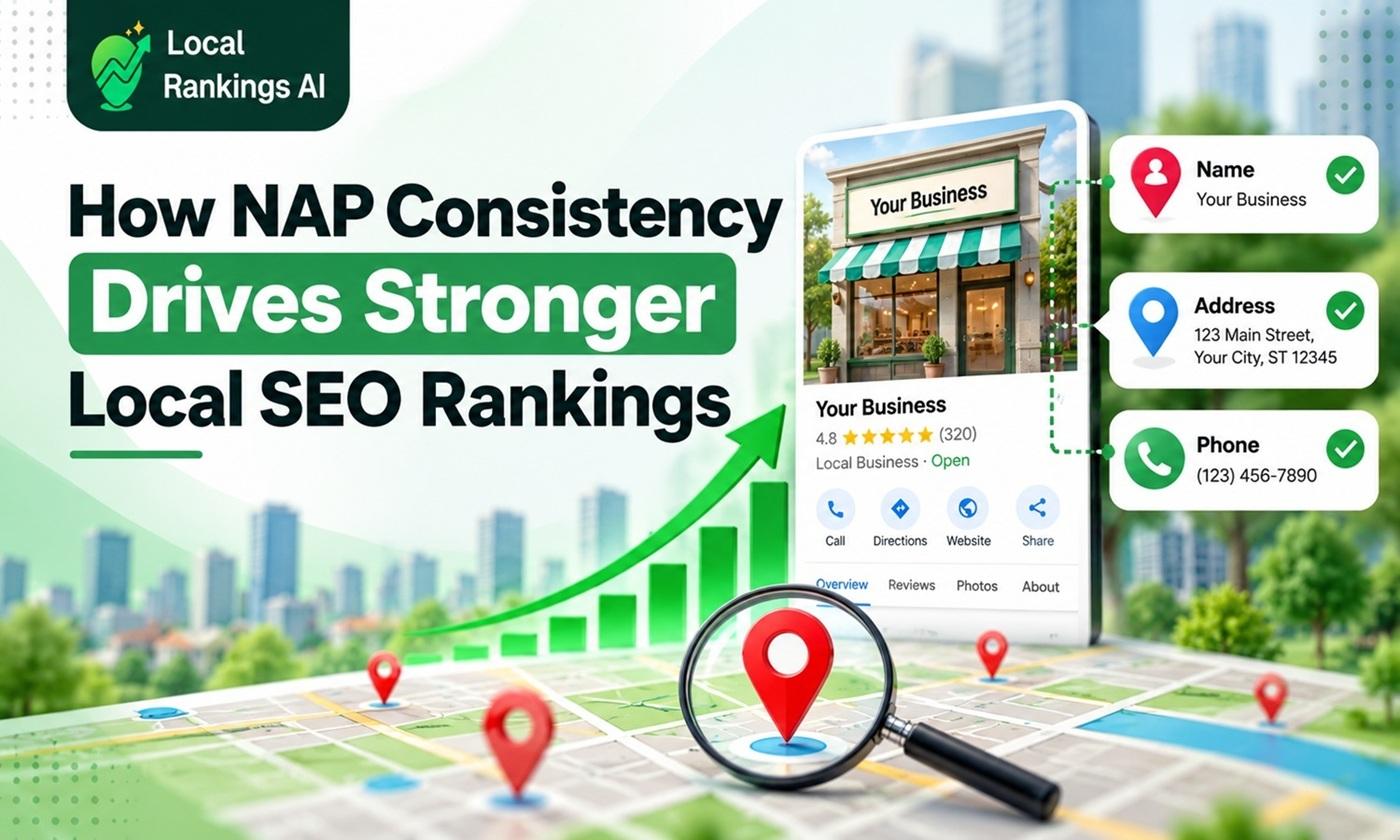
How NAP Consistency Drives Stronger Local SEO Rankings
When customers find different addresses or phone numbers for your business, trust takes a hit. Discover how accurate NAP data strengthens local search presence.
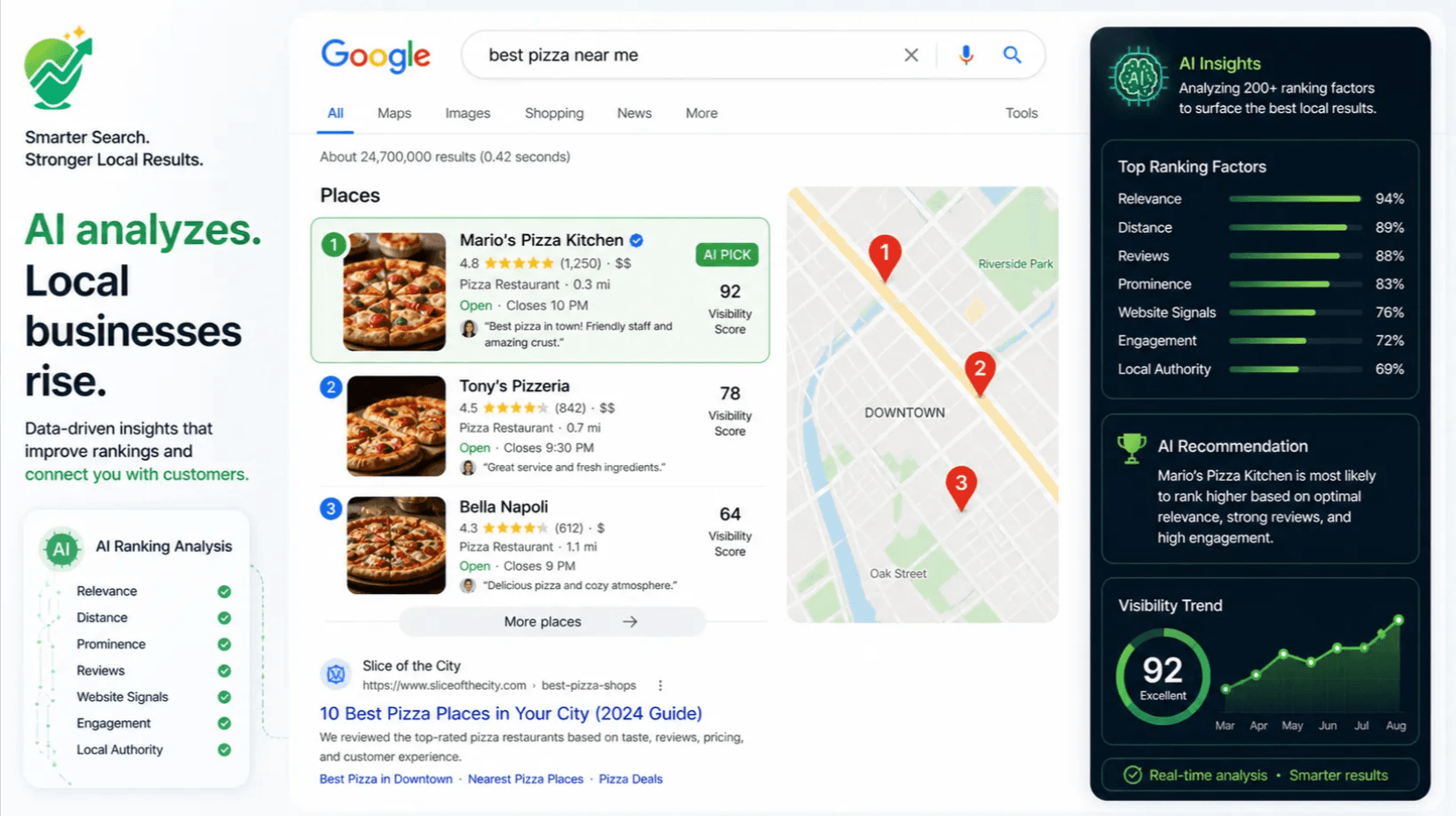
Consistent NAP data across Google, Bing, Yelp, and Apple builds search engine trust. Google assesses a business’s relevance to a specific location using this information. Inconsistent citations confuse local algorithms, dropping Map Pack rankings. Local Rankings AI’s precision geo-rank grid pinpoints where NAP discrepancies hurt visibility, enabling targeted corrections that restore ranking position.
Inconsistent NAP data confuses local algorithms and drops Map Pack rankings.
Search engines cannot confidently rank businesses when citations conflict across platforms.
Citation errors create geographic blind spots where businesses become invisible in local searches.
A precision geo-rank grid pinpoints street-level areas where NAP discrepancies suppress visibility.
What is NAP consistency and why does it matter?
NAP stands for Name, Address, and Phone number. Consistent NAP data across all online platforms is critical for local SEO performance. Search engines like Google use this information to assess a business's relevance to a specific location. Inconsistent listings erode credibility and push potential customers toward competitors with cleaner data.
A consistent NAP across platforms helps search engines build credibility and trust, ensuring a smooth and positive user experience. When Google encounters conflicting business details, the search engine cannot confidently rank the business in local results. Local business owners lose visibility they never see reported.
Why does Google care about NAP accuracy?
Google wants to provide customers with relevant and trustworthy information. Maintaining an accurate NAP on Google Business Profile is essential for optimal visibility in search results. Inaccurate listings create friction for users and signal unreliability to search algorithms.
How do businesses fix NAP inconsistencies?
Local Rankings AI provides tools to audit and maintain business profiles across platforms like Google, Bing, Apple, and Yelp. The platform identifies discrepancies at the street level and generates actionable tasks. Business owners can follow a structured process to correct errors:
Run a full audit of all directory listings and business profiles.
Identify every platform where the name, address, or phone number differs.
Correct each listing to match the canonical business information exactly.
Monitor listings continuously for new inconsistencies or unauthorized changes.
For a deeper walkthrough of correcting citation errors, see this guide on fixing NAP issues for local rankings. NAP consistency solutions for local SEO require ongoing monitoring, not one-time cleanup.
How does NAP inconsistency hurt your local rankings?
NAP inconsistency directly damages local search rankings by eroding the trust signals search engines rely on. Google and other search engines evaluate a business’s credibility through the accuracy of its name, address, and phone number across the web. When that data conflicts, the algorithm cannot confidently match the business to local queries.
The damage compounds quickly. A consistent NAP across platforms helps search engines assess a business’s relevance to a specific location while building the credibility needed for a smooth user experience.
Conflicting citations strip away that credibility.
The search engine hesitates.
Rankings drop. Visibility shrinks.
Potential customers find a competitor instead.
Many business owners remain unaware of the mistakes harming their visibility. These errors cause them to lose potential customers without any obvious warning. A phone number with an old area code on one directory and a new one on another creates confusion. An address formatted differently across listings signals unreliability. Each discrepancy chips away at the authority a business has built.
What happens when search engines encounter conflicting business data?
Search engines face a direct conflict when citations disagree. The algorithm must choose which version to trust. Often it trusts none. The business then fails to appear for searches it should dominate. Rankings fall across the entire service area, not just at a single point.
How do citation errors create blind spots in local visibility?
Citation errors create geographic blind spots where a business becomes invisible. Local Rankings AI provides a precision geo-rank grid that identifies exactly where a business underperforms across its service area. Street-level ranking data reveals the specific neighborhoods and zip codes where discrepancies suppress visibility. Without this granular insight, a business never knows how many leads slip away.
NAP Consistency Solutions for Local SEO address these problems through systematic citation audits and corrections. The process restores the trust signals search engines demand. Rankings stabilize. Visibility returns to the areas where discrepancies once blocked it.
What are the first steps to audit your NAP data?
A NAP audit begins with a complete inventory of every online platform displaying business information. This inventory spans major search engines, mapping services, and industry-specific directories.
How does a business compile a full citation inventory?
Start by searching for the business name and address on Google, Bing, Apple Maps, and Yelp. Record every listing found, including those on niche directories relevant to the industry. A comprehensive list prevents overlooked discrepancies that erode search engine trust.
List all existing platforms: Document every site where the business appears, from Google Business Profile to local chamber of commerce pages.
Run a business profile audit: Deploy an audit tool to scan for inconsistencies in name, address, and phone number across all identified citations.
Flag every variation: Mark any discrepancy, no matter how minor. Differences like “St.” versus “Street” or mismatched suite numbers create conflicting signals for search engines.
Document findings meticulously: Create a master record of each citation and its current NAP details. This record becomes the single source of truth for corrections.
What specific discrepancies cause the most ranking damage?
Phone number inconsistencies and address abbreviations cause the most frequent harm. A consistent NAP across platforms helps search engines assess a business’s relevance to a specific location. Conflicting details undermine that assessment. The Local Rankings AI platform tracks, enhances, and maintains business profiles to ensure compliance. Its business profile audit identifies these exact errors, flagging variations that manual checks often miss. Without correction, these small mismatches cost a business its hard-earned local visibility.
How do you fix NAP inconsistencies across directories?
Fixing NAP inconsistencies requires a systematic audit followed by targeted corrections. Businesses lose local search visibility when name, address, and phone number data conflicts across platforms. The process demands both thoroughness and prioritization to restore search engine trust efficiently.
What is the first step in correcting NAP errors?
The first step involves conducting a comprehensive citation audit. A business must identify every directory listing where its information appears and document discrepancies. This audit reveals the full scope of the problem before any corrections begin.
Audit existing citations. Compile a complete list of all directories, platforms, and data aggregators where the business is listed. Record the exact name, address, and phone number displayed on each.
Prioritize high-authority platforms. Focus initial corrections on Google Business Profile, Bing Places, and Apple Maps. Maintaining an accurate NAP on Google Business Profile is essential for optimal visibility in search results, as Mastering NAP Consistency: A Guide for Local SEO Success notes.
Correct each citation. Update inaccurate listings manually or use automated tools to push corrected NAP data across all directories simultaneously. Local Rankings AI provides actionable AI tasks that guide users to make effective changes for improved visibility.
Verify and monitor results. After corrections propagate, monitor rankings using real-time geo-rank data. This step confirms improvements in local search performance and identifies any remaining blind spots.
How long does it take for NAP corrections to impact rankings?
Search engines require time to recrawl and reindex corrected citations. The impact on rankings typically materializes over several weeks as consistency signals strengthen. Continuous monitoring ensures that corrections hold and that no new discrepancies emerge across the directory ecosystem.
How can you maintain NAP consistency long-term?
Long-term NAP consistency demands continuous monitoring, not a one-time cleanup. Business information drifts across directories, review sites, and data aggregators as platforms update, merge, or scrape listings. Without a systematic maintenance plan, even a perfectly corrected profile degrades within months. The cost of inaction is lost search visibility that competitors capture instead.
What routine keeps NAP data accurate over time?
A structured audit cadence prevents small errors from compounding into ranking penalties. NAP Consistency Solutions for Local SEO require three ongoing practices:
Schedule monthly business profile audits across Google, Bing, Apple Maps, and Yelp to catch new inconsistencies as they appear.
Deploy street-level rank tracking to identify geographic blind spots where incorrect citations weaken local visibility.
Generate client-ready documentation after each audit cycle to measure improvement and justify continued investment.
Local Rankings AI automates these workflows. The platform performs business profile audits, tracks ranking changes at a street level, and surfaces actionable tasks when discrepancies emerge. Multi-location operators gain particular advantage here: manual citation management across dozens of locations becomes unsustainable without automation.
How does consistent NAP data strengthen multi-location visibility?
Search engines treat accurate, uniform business information as a trust signal. Consistent NAP data strengthens search engine confidence and powers multi-location Google Maps visibility over time. Each verified citation reinforces the entity's legitimacy. Fragmented or outdated listings produce the opposite effect: search engines hesitate to surface a business they cannot confidently verify.
Businesses that pair automated monitoring with NAP optimization tools close the gap between detection and correction. The result is a defensible local presence that resists the drift competitors ignore.
Frequently Asked Questions
Conclusion
NAP consistency is not a one-time fix but a continuous competitive advantage. By committing to a structured audit cadence and leveraging automated monitoring to catch discrepancies as they appear, you build a defensible local presence that resists the data drift competitors ignore. The decision to act on these inconsistencies today directly determines whether your business captures or loses the next local search opportunity.