5 Signs You Need Local SEO Marketing Software Now | Local Rankings AI
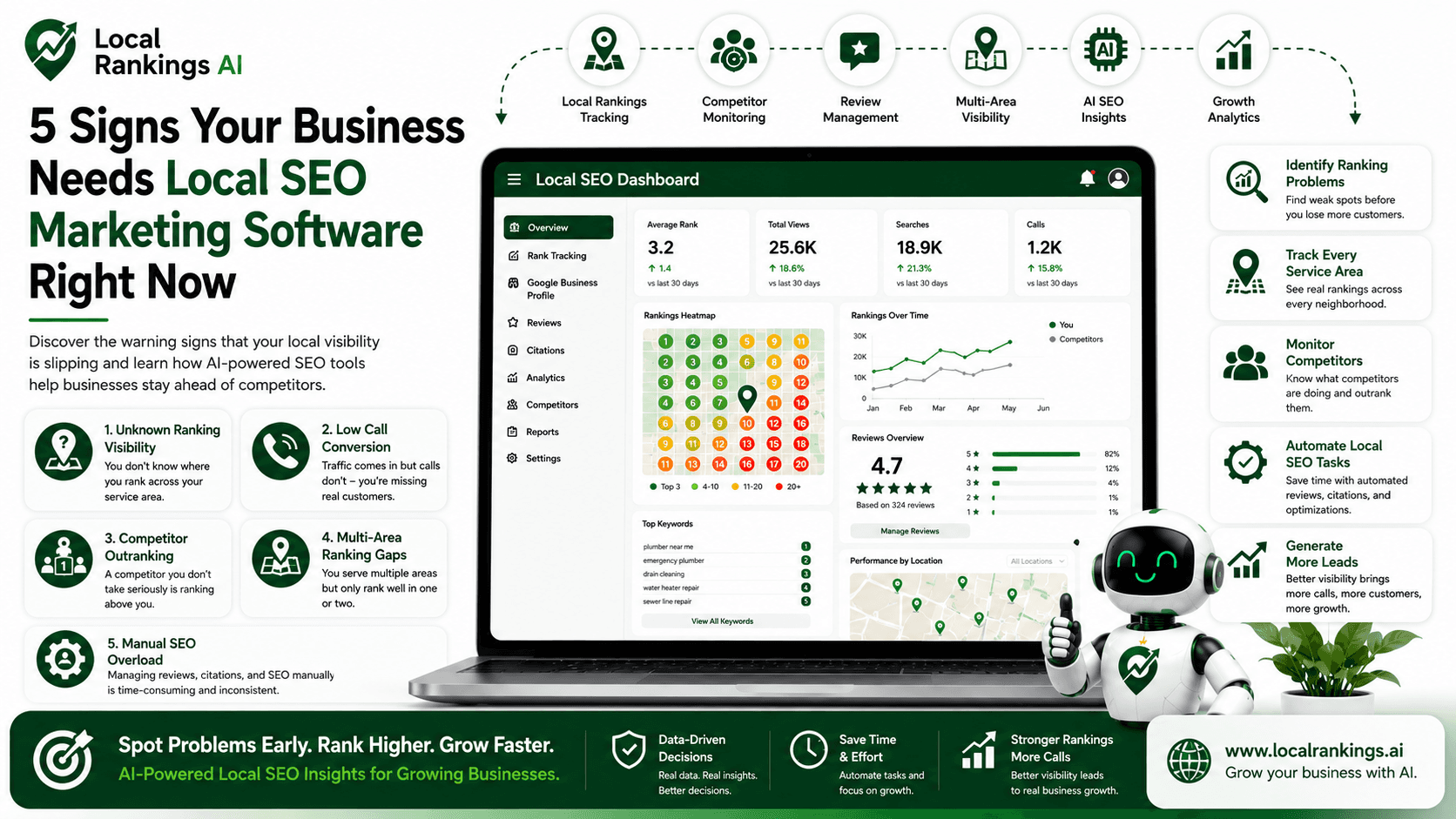
5 Signs Your Business Needs Local SEO Marketing Software Right Now
Most businesses don't realize local SEO is failing until customers choose a competitor instead. Discover 5 warning signs and how software helps you stay visible.
Most local businesses don't realize there's a problem until they've already lost customers to a competitor they've never heard of. These five signs tell you whether that's already happening to you.
Local SEO doesn't fail loudly. There's no error message, no notification, no moment where Google tells you that you've fallen off the map for the customers who matter most. It fails quietly - through leads that never came in, calls that went to someone else, and neighborhoods you thought you were serving but weren't visible in at all.
The businesses that catch this early are the ones using the right tools. The ones that don't usually find out too late - when a competitor has already locked up the areas they assumed were theirs.
Here are five signs that your business is already past the point of managing local SEO manually.
5 Signs You Need Local SEO Marketing Software Before It's Too Late
Sign #1: You Don't Actually Know Where You Rank — You Just Assume
Most business owners have checked their Google ranking at some point. They searched their own name or a key phrase, saw themselves near the top, and moved on. What they didn't check is how that ranking changes for someone searching from a different street, a different neighborhood, or the edge of their service area.
Local search rankings are not fixed. Google adjusts results based on where the searcher is standing at the moment they type. A business that ranks second from its own office might not appear until page two for someone searching from five kilometers away - even if that person is well within the service area you're paying to operate in.
If your understanding of your own ranking comes from a single search you ran yourself, you don't actually have ranking data. You have one data point from one location, which is a different thing entirely.
Checking your rankings across your full service area - not just from your front door - is the only way to know whether your local SEO is actually working or just appearing to work from where you're sitting.
Sign #2: You're Getting Traffic but Not Calls
This one catches businesses off guard because it feels like a website problem, not a local SEO problem. Traffic is coming in, the site looks fine, but the phone isn't ringing at the rate it should be.
In most cases, the issue isn't the website itself — it's a mismatch between the traffic arriving and the intent behind the searches driving it. When your local SEO isn't properly targeting the right geographic areas with the right signals, you attract visitors who are browsing rather than buying. They're not ready to call because they weren't looking for someone in your specific area to begin with.
The other common cause is review presence. A business with thin or inconsistent reviews creates doubt at the exact moment a potential customer is deciding whether to call. They found you, they looked at your profile, and something in what they saw — or didn't see — made them keep scrolling.
Both of these are local SEO problems. Automating your review generation and ensuring your visibility is matched to genuine buying intent in your area addresses both at once, rather than chasing the symptom through website changes that won't fix the underlying cause.
Sign #3: A Competitor You've Never Taken Seriously Is Outranking You
There's a particular frustration that comes with discovering a competitor you've always considered smaller, newer, or less established is consistently appearing above you in local search results. It feels wrong. But it's usually explainable.
Local search rankings are not a straight reflection of how good your business is or how long you've been operating. They're a reflection of how well your local SEO signals are managed — your Google Business Profile completeness, your review velocity, your citation consistency, and increasingly, how well your presence is structured for AI-powered search.
A newer competitor who has invested in the right platform from the start will often outrank an established business that's been coasting on its reputation. The signals Google looks for don't know how many years you've been in business. They only know what's in front of them.
If this is happening to you, the gap is closeable — but not by guessing. You need to understand exactly which signals that competitor has that you don't, and where in your service area they're outperforming you. Seeing a street-level breakdown of your rankings compared to what's around you is where that kind of diagnosis starts.
Sign #4: You Serve Multiple Areas but Only Rank Well in One
This is one of the most common growth blockers for local businesses — and one of the least visible without the right data. A business expands its service area, adds new locations or coverage zones to its website, and assumes the ranking will follow. It usually doesn't, at least not automatically.
Ranking in multiple areas requires a deliberate, location-specific strategy. Each zone has its own competitive landscape, its own proximity dynamics, and its own set of signals that Google weighs when deciding what to show. A single optimized location page and a general GBP listing aren't enough to establish presence in areas where searchers are further from your physical address.
Managing this manually across three, five, or ten service zones is not realistic. The data volume alone — tracking which keywords are performing in which areas, identifying which zones are underserved, understanding which competitor is winning where — requires software that processes it systematically rather than someone checking rankings by hand every week.
If your business is geographically larger than a single location but your leads are concentrated in one area, this is almost certainly what's happening. Understanding how visibility varies across your platforms and service zones is the first step toward fixing it.
Sign #5: You're Still Managing Local SEO Manually
There's a version of local SEO management that works fine when a business is small, early-stage, and operating in a limited area. You update your GBP when you remember, respond to reviews when you notice them, and check your ranking occasionally. It's imperfect but functional.
That approach stops working at a certain point — and most businesses cross that threshold before they realize it. The volume of signals that influence local rankings has grown significantly. Review consistency, citation accuracy across dozens of directories, GBP post frequency, AI-search-ready structured data, service-area-specific content — managing all of this manually means something is always slipping.
The businesses that are pulling ahead in local search right now aren't necessarily working harder on SEO. They're working more systematically. They have software that catches inconsistencies automatically, surfaces ranking drops before they become trends, and keeps the review pipeline running without requiring someone to remember to send a follow-up.
If your current approach to local SEO is a combination of occasional manual updates and hoping the ranking holds, the gap between you and a competitor using proper software is widening every month — even if you can't see it yet.
Exploring what done-for-you local SEO management covers is worth understanding even if you're not ready to hand everything off — because it shows you exactly what a systematic approach looks like compared to what you're currently doing. Schedule Demo
What to Do If You Recognize These Signs
Recognizing the problem is the straightforward part. The harder question is where to start.
The most practical first step is getting an honest baseline — not a single ranking check from your own address, but a full picture of your visibility across the geographic area you actually serve. Until you have that, every other decision is based on incomplete information.
From there, the priority order is usually consistent: fix the GBP gaps that are suppressing your baseline rankings, get reviews generating systematically rather than sporadically, clean up your citation inconsistencies, and then build outward into the service area zones where you're currently invisible.
None of this is complicated in principle. What makes it difficult without software is the volume — the number of signals to track, the number of locations to monitor, the number of directories to keep consistent. That's the problem the right platform solves.
Start by seeing your real rankings for free — mapped across your full service area, not just your front door. It takes under 60 seconds and immediately shows you whether the signs above are already playing out in your data.
The Reality Most Local Businesses Miss
Local SEO doesn't announce when it stops working. There's no moment where Google sends a notification that your visibility has dropped in the northeast corner of your service area, or that a competitor has started outranking you for your most valuable keyword three suburbs over.
The businesses that find out early are the ones with software that surfaces these changes as they happen. The ones that find out late usually discover it through a conversation with a customer who almost went elsewhere, or a quarterly review where the lead numbers don't add up.
If any of the five signs in this article felt familiar, you're not past the point of fixing it — but the window for easy correction does get smaller the longer the underlying issues compound.