AI SEO Tools in 2026 | What Local Businesses Must Know | Local Rankings AI
How AI SEO Tools Are Changing Search Optimization in 2026
Discover how AI SEO tools are transforming search optimization in 2026 with smarter keyword research, automation, content insights, and improved rankings.
June 21, 20269 min read
Search has changed more in the last 18 months than it did in the previous decade. Google's AI Overviews now answer questions before users even scroll. ChatGPT sends traffic to businesses it trusts. Apple's Siri and Bing's Copilot pull recommendations from sources they've indexed as credible. And the business ranking #1 in traditional search? It might be invisible to someone asking the same question through an AI assistant two blocks away.
For local businesses, this shift is not abstract. It's customers finding your competitor instead of you — not because you did anything wrong, but because your SEO strategy was built for a world that no longer fully exists.
How AI SEO Tools Are Reshaping Local Search Optimization in 2026
What "Search Optimization" Actually Means in 2026
The phrase "search optimization" used to have a clear definition: rank on Google's first page for your target keywords. That's still relevant. But in 2026, search optimization means something broader.
It now means:
Traditional Google rankings — organic positions for local intent keywords
GEO (Generative Engine Optimization) — being cited or referenced by AI-generated answers on platforms like ChatGPT, Perplexity, and Google's AI Overviews
AEO (Answer Engine Optimization) — structuring your content so it directly answers the specific questions your customers are asking, in a format AI systems can extract and use
Businesses that only focus on one of these three are leaving visibility on the table. And for local businesses — where every missed impression in your service area is a missed call — that gap adds up fast.
Why Local SEO Is the Hardest Problem AI Is Finally Solving
Local search has always had a problem that national SEO doesn't: geography. A plumber in Chicago doesn't rank the same in Lincoln Park as they do in Wicker Park. A dentist in Austin might be #1 for searches near their office but invisible three miles away.
Traditional rank tracking tools hid this. They'd show you one average position across your city and call it a day. You thought you were ranking. Your customers a few blocks over were seeing someone else entirely.
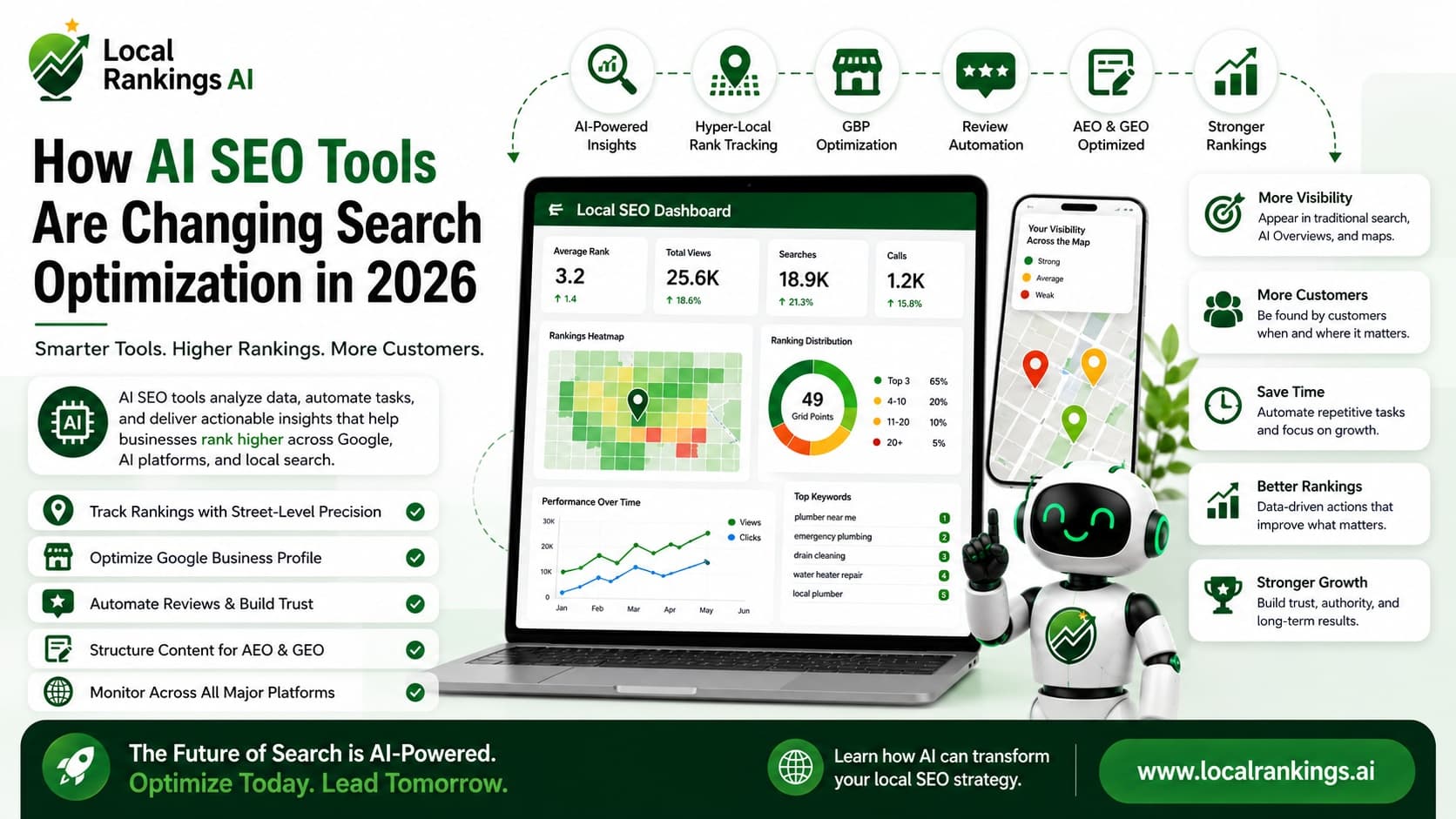
AI-powered local SEO platforms likeLocal Rankings AI solve this by tracking your visibility at a street-level grid — mapping exactly where you're ranking, where you're losing ground, and where your competitors are outperforming you. Instead of one number, you get a geo-rank heatmap that shows your real footprint across your entire service area.
This is the foundation everything else is built on. You can't fix what you can't see.
How AI Tools Are Changing the Four Pillars of Local SEO
1. Rank Tracking Gets Hyper-Local
Old rank tracking gave you a single keyword position. AI-powered rank tracking gives you a 7×7 geo-grid — 49 distinct data points across your service area — updated in real time.
This matters because Google's local algorithm weighs proximity heavily. The same search query delivers different results depending on where the searcher is standing. If your tracking doesn't account for that, you're optimizing based on incomplete data.
Tools built for this - like theRankings engine inside Local Rankings AI - don't just show you where you rank. They show you where you're losing visibility and which zones your competitors have claimed, so you can prioritize your efforts with precision.
2. Google Business Profile Optimization Becomes Predictive
Your Google Business Profile is no longer just a listing. In 2026, it's one of the primary signals AI assistants use to verify local business credibility. Completeness, consistency, category accuracy, photo freshness, Q&A coverage — these are now factors not just for Maps rankings but for whether AI platforms surface your business at all.
AI-poweredbusiness profile auditing identifies exactly what's missing or misaligned in your profile before it costs you rankings. Rather than manually comparing your profile against best practices, the platform flags gaps and prioritizes fixes based on ranking impact.
3. Review Generation Becomes a Ranking Signal — Not Just a Trust Signal
Reviews have always built trust. In 2026, they will also directly feed the AI ranking ecosystem. Google's AI Overviews, ChatGPT's local recommendations, and voice assistants all draw from review volume, recency, and sentiment when deciding which businesses to surface.
A business with 12 reviews updated 14 months ago and a competitor with 80 reviews including 20 from the last 60 days — the AI isn't guessing which one to recommend. It's doing math.
AI Review Automation from Local Rankings AI handles this systematically: identifying the right moments in the customer journey to request reviews, automating follow-up, and helping you build a consistent flow of fresh, authentic reviews that both Google and AI platforms trust.
4. On-Page and Technical SEO Gets Structured for AI Extraction
This is where AEO and GEO come in directly. AI search systems don't read content the way a human does. They extract answers. They look for structured data, clear question-and-answer formatting, schema markup, and content that directly addresses the user's query without burying the answer.
If your service pages and blog content aren't structured to be answer-extractable, you won't appear in AI Overviews or get cited by ChatGPT — even if your content is excellent.
Thewebsite enhancement tools in Local Rankings AI are built specifically for this: optimizing your site structure and content formatting so it performs across traditional search and AI-generated results simultaneously.
The Platforms That Now Shape Local Visibility
Local SEO in 2026 doesn't live on Google alone. Customers are discovering businesses through:
Google (Search, Maps, AI Overviews)
Bing / Microsoft Copilot
Apple Maps / Siri
ChatGPT (with browse and plugins enabled)
Facebook (local recommendations and search)
Yelp (still a primary source for restaurant, service, and home categories)
Each platform has its own signals, but they share common inputs: consistent NAP (name, address, phone) data across directories, review velocity, structured website content, and active business profiles.
An AI-powered local SEO platform gives you visibility across all of these — not as separate projects, but as a unified system. You can see how your presence stacks up across platforms and address gaps without managing six different tools.
What EEAT Means for Local Businesses in the AI Era
Google's EEAT framework — Experience, Expertise, Authoritativeness, and Trustworthiness — has become more important as AI-generated content floods the web. Google is doubling down on signals that prove real-world credibility, and local businesses actually have a natural advantage here.
Your years in the field, your customer reviews, your verified business profile, your local press mentions, your service history - these are genuine EEAT signals. The problem is most local businesses haven't made them visible in a way Google and AI platforms can easily process.
Practical ways to strengthen EEAT for local SEO:
Add genuine author bios to blog content with verifiable credentials
Use first-person case studies and before/after examples from real client work
Publish content that answers hyper-local questions your customers actually ask
Earn citations from local directories, news outlets, and industry associations
Keep your Google Business Profile active with fresh photos, posts, and responses
The businesses that win the next phase of local search won't just be the ones who optimize harder. They'll be the ones who make their real-world expertise legible to AI systems.
Self-Serve or Done-For-You: Knowing Which Fits Your Situation
One thing worth understanding about AI SEO tools in 2026: access to data isn't the bottleneck anymore. The bottleneck is implementation.
A small local business owner who can see exactly where they're losing rankings but has no time to act on it isn't better off than one who has no data. Local Rankings AI addresses this directly by offering two paths: a self-serve platform with guided recommendations for those who want control, and adone-for-you service where their team handles setup, optimization, review generation, and ongoing monitoring.
Neither approach is universally better. The right choice depends on your time, your team, and how competitive your local market is.
Conclusion
AI hasn't made local SEO simpler — it's made it higher-stakes. The businesses that show up consistently across Google, Bing, Apple, and AI assistants will capture an increasingly large share of local search intent. The ones still relying on single-position rank tracking and static profiles will find themselves losing ground they can't even see yet.
The good news: the tools to compete at this level are no longer reserved for enterprise budgets. Platforms likeLocal Rankings AI exist specifically to give local businesses the same geo-level visibility, AI-powered insights, and structured optimization that large brands have had for years.
The search landscape has shifted. The businesses that adapt now will be the ones customers find — block by block, platform by platform, question by question. Sign Up