AI-Based SEO Tools vs Traditional SEO Tools: What's the Difference?
AI SEO tools go beyond reporting by providing actionable insights, geo-grid tracking, review automation, and multi-platform visibility to boost local search performance.
AI SEO tools have fundamentally changed how businesses approach search visibility - but not everyone is convinced the shift is worth making. If you have been using traditional SEO tools for years and they seem to be working, the case for switching is not always obvious from the outside. The reality, though, is that the gap between what AI-powered platforms can do and what traditional tools offer has grown significantly, particularly for businesses competing in local markets.
This guide breaks down the practical differences between AI-based SEO tools and traditional SEO tools - not in terms of marketing language, but in terms of what each one actually does for your visibility, your time, and your results. By the end, you will have a clear picture of where each approach fits and how to decide which one makes sense for your business right now.
AI SEO Platforms vs Traditional SEO Software: A Practical Comparison
What Traditional SEO Tools Actually Do
Traditional SEO tools are built around data collection and reporting. They track keyword rankings, analyse backlink profiles, crawl your website for technical errors, and pull together competitive data. Some of the most established platforms in this space have been doing this reliably for well over a decade, and for large agencies managing complex national campaigns, they remain genuinely useful.
The core limitation of traditional tools is that they surface information without telling you what to do with it. You see that a keyword dropped three positions - but the tool does not tell you why, or what change would most likely reverse the decline. You get a list of technical errors - but not a clear sense of which ones are actually affecting your rankings versus which ones are low priority. The interpretation and prioritisation falls entirely to you.
For experienced SEO professionals with deep platform knowledge, this is manageable. For business owners trying to improve their own visibility, or for agencies managing a high volume of local clients, it creates a bottleneck. The data is there - but acting on it efficiently requires expertise that many businesses simply do not have in-house.
How AI SEO Tools Work Differently
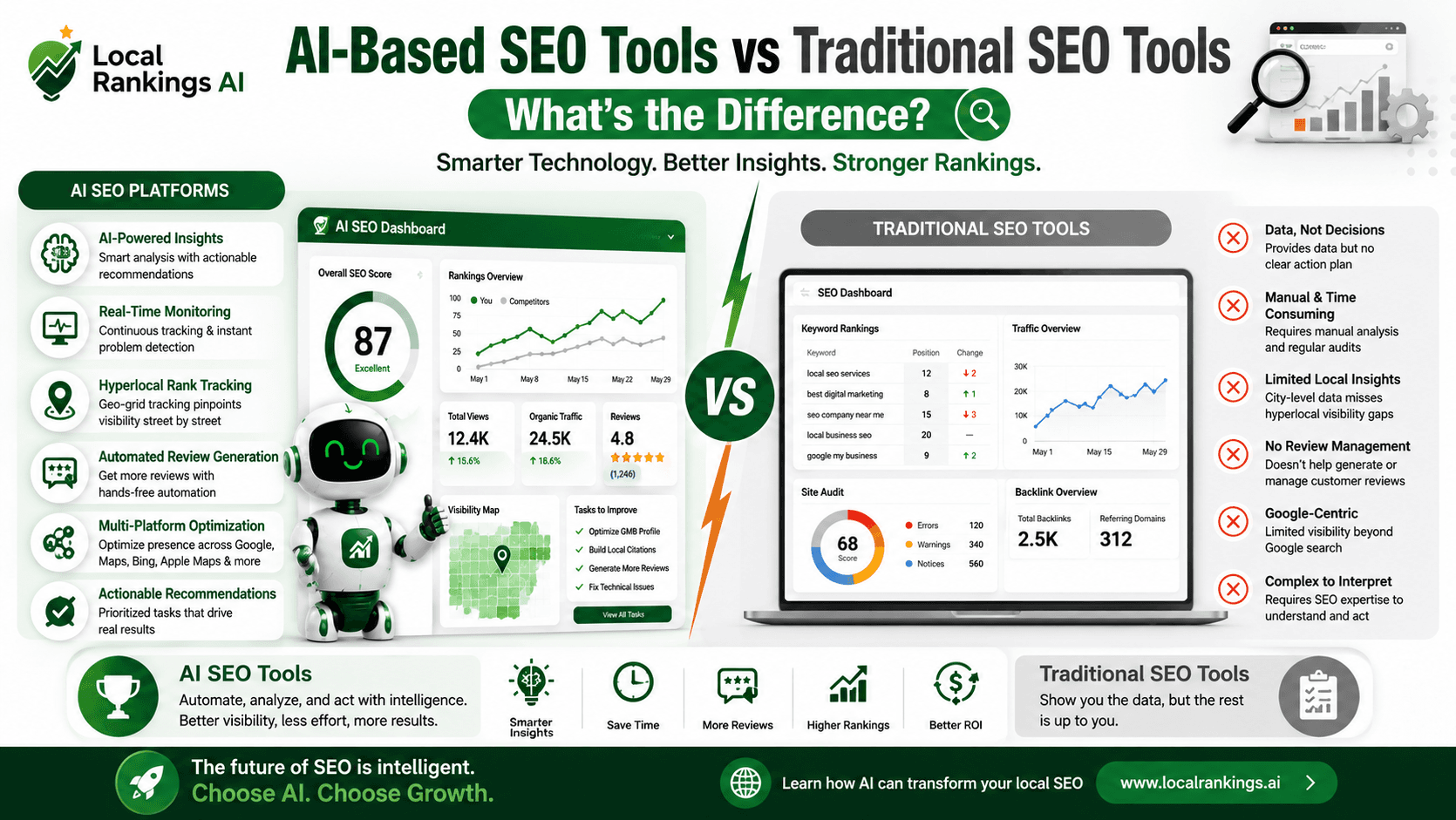
AI SEO tools are built on a different premise. Rather than presenting raw data and leaving interpretation to the user, they analyse the data themselves and generate specific, prioritised recommendations. The goal is not just to inform - it is to guide action. This distinction sounds simple, but in practice it changes the entire workflow.
Instead of logging into a dashboard and deciding what to look at, an AI SEO tool continuously monitors your visibility in the background and flags the changes that matter. Instead of running a manual audit every quarter, the platform identifies emerging problems in real time. And instead of working through a generic checklist, the recommendations are specific to your business, your market, and your current ranking position.
For local businesses especially, this shift is significant. You can explore how this works in practice on the Local Rankings AI how-it-works page - the platform combines geo-grid rank tracking, AI-driven task recommendations, and review automation into a single workflow designed specifically for local visibility.
Side-by-Side: Where the Two Approaches Differ Most
Rank Tracking: City-Level vs Street-Level
Traditional SEO tools typically track one ranking position per keyword - giving you a single number that represents your visibility across an entire area. For national campaigns, this is often sufficient. For local businesses competing in a specific service area, it misses the most important detail: where exactly within that area you are visible and where you are not.
AI SEO tools built for local search use geo-grid technology to track rankings at multiple points across your service area - often checking 49 or more locations in a single scan. This reveals visibility patterns that a single ranking number simply cannot capture. A business might rank well near its physical address but drop significantly just a few streets away - and without geo-grid tracking, that gap is invisible.
Recommendations: Manual Interpretation vs Guided Action
With traditional tools, the path from data to action runs through a human expert. Someone needs to look at the rankings, cross-reference competitor data, review technical errors, and decide what matters most. That process takes time, requires expertise, and introduces the risk of prioritising the wrong things.
AI SEO tools short-circuit that process. The platform handles the analysis and presents a prioritised list of actions ranked by expected impact. For business owners without a background in SEO, this removes a major barrier to making consistent progress. For agencies, it means more capacity to focus on strategy rather than routine analysis.
Review Management: Manual Follow-Up vs Automated Generation
Traditional SEO tools typically do not include review management at all - it falls outside the scope of what most platforms were built to do. Yet reviews are one of the most powerful local ranking signals available, and managing them manually at scale is not realistic for most businesses.
AI SEO tools designed for local search treat review generation as a core feature, not an add-on. Automated review requests go out to customers at the right moment, without requiring manual follow-up for every transaction. The result is a consistent, steady growth in review volume - which search engines reward with stronger local visibility over time.
Platform Coverage: Single-Channel vs Multi-Platform
Traditional SEO tools are primarily built around Google. That made sense when Google was the only search platform worth tracking, but the landscape has changed. Local customers now discover businesses through Bing, Apple Maps, Yelp, Facebook, and increasingly through AI-powered search platforms like ChatGPT and Perplexity.
AI SEO tools that are built for 2026 help you maintain consistent, optimised business information across all of these channels simultaneously. Visibility in one place no longer guarantees visibility everywhere - and platforms that only monitor Google leave significant blind spots unaddressed.
Reporting: Raw Data vs Readable Progress
Traditional SEO tools generate detailed reports - sometimes very detailed. The challenge is that interpreting those reports requires context and experience. A business owner looking at a 200-page crawl audit is not getting actionable insight; they are getting data that needs to be translated by someone who knows what to look for.
AI SEO tools present reporting in a format that tells a story. Ranking improvements are visualised over time. Review growth is charted clearly. Visibility across the service area is shown on a map. The output is designed to be understood without specialist knowledge - which matters whether you are reviewing your own performance or presenting results to a client.
When Traditional SEO Tools Still Make Sense
Traditional tools are not obsolete - they still serve a purpose in the right context. Large enterprise SEO teams with dedicated specialists benefit from the depth of technical crawling and backlink analysis that established platforms provide. Content-focused agencies producing large volumes of written material may find specialised content scoring tools more useful than a broad local visibility platform.
The key question is what your primary SEO challenge actually is. If you are a local business trying to rank in your service area, attract more calls and enquiries, and manage your online reputation consistently - a traditional tool is unlikely to give you the granular local data and guided recommendations you need. If you are managing a complex technical website with thousands of pages and a sophisticated link-building programme, a traditional platform may still form part of your toolkit.
For most local businesses in 2026, however, the practical advantages of AI-driven platforms - real-time guidance, geo-level visibility, automated review management, and multi-platform coverage - outweigh the depth that traditional tools offer in areas that are less relevant to local search performance.
Making the Switch: What to Expect
Transitioning from a traditional SEO tool to an AI-powered platform is typically straightforward. Most platforms are designed for quick onboarding - you connect your business profiles, define your service area, and the tool begins mapping your visibility and surfacing recommendations almost immediately.
The adjustment that takes slightly longer is changing how you engage with the data. Traditional tools reward users who spend time exploring dashboards and drawing their own conclusions. AI SEO tools work better when you trust the recommendations, act on them consistently, and measure progress over time rather than looking for immediate ranking jumps.
If you want to understand the full workflow before committing, Local Rankings AI offers a detailed walkthrough of how the platform approaches local visibility - from geo-grid tracking to review automation and profile optimisation. You can also sign up and test it against your real business data before making any long-term commitment.
Wrapping Up: Which Approach Is Right for Your Business?
The difference between AI SEO tools and traditional SEO tools is not just about technology - it is about how much of the thinking you want the platform to do for you. Traditional tools give you data. AI tools give you direction. Both have a role, but for local businesses trying to improve visibility in a specific area, the guided, automated, multi-platform approach that AI-powered platforms provide is increasingly hard to match manually.
If your current tools are telling you what your rankings are but not helping you understand why they are moving or what to do next, it is worth exploring whether an AI SEO tool would close that gap. The best way to find out is to test one against your own data in your own market - and see for yourself what the difference looks like in practice.
Sign Up